Best S&P 500 ETFs of 2026: VOO vs IVV vs SPY vs SPLG
Only 8% of active large-cap funds beat a simple S&P 500 index fund over 10 years. Compare the best S&P 500 ETFs of April 2026 — VOO, IVV, SPY, and SPLG.

Key Takeaways
Only 21% of actively managed large-cap funds survived and beat their passive index peers over the 10 years through June 2025, according to Morningstar — meaning passive S&P 500 ETFs outperform roughly four out of five professional stock pickers over the long run.
The S&P 500 has returned an average of 10.42% annually over the past 100 years, and 15.75% annually over the past decade through end-2025.
The cheapest S&P 500 ETF in 2026 is SPLG at 0.02% per year — costing just $2 annually on every $10,000 invested.
VOO and IVV are the best long-term holds for most investors at 0.03% expense ratios, while SPY is the better choice for options traders who need maximum daily liquidity.
UK, Canadian, and Australian investors have direct access to S&P 500 ETFs through tax-advantaged accounts including Stocks and Shares ISAs, RRSPs, and superannuation funds.
Consider this before paying a fund manager: only 21% of actively managed large-cap US equity funds survived and beat their average passive index peer over the decade ending June 2025, according to Morningstar's active-passive barometer. In the large-cap blend category specifically — the segment where most professional stock pickers operate — the figure drops to just 8%. Passive investing, anchored by low-cost S&P 500 ETFs, is not a compromise. For the overwhelming majority of individual investors, it is the superior strategy by the numbers.
The case gets stronger when you factor in cost. An active large-cap fund charging a typical 0.65% expense ratio costs 21 times more per year than VOO or IVV at 0.03%. That gap compounds into a significant drag over 20 or 30 years. In 2025, passive large-blend ETF strategies attracted $353 billion in net new flows — while more than $375 billion simultaneously left active large-blend strategies, according to Morningstar data. Investors are voting with their wallets.
This guide identifies the four best S&P 500 ETFs of April 2026, explains the structural differences that matter beyond the headline expense ratio, gives you a clear decision framework for choosing between them, and covers the best options for investors in the UK, Canada, and Australia who want the same exposure through local exchanges and tax-advantaged accounts.
Why S&P 500 ETFs Beat Most Investors Over Time
The S&P 500 tracks the 500 largest publicly listed US companies by market capitalization — a diversified cross-section of the US economy spanning technology, healthcare, financials, consumer goods, industrials, and energy. When you buy an S&P 500 ETF, you are buying a fractional stake in all 500 companies simultaneously, weighted by their size, for the cost of a single trade.
The long-run return is compelling. Since 1957, when the index reached its current composition of 500 stocks, the S&P 500 has averaged 10.59% annually. Over the past 30 years through December 2025, the average is 10.4% per year. Over the past decade, it has averaged 15.75% per year — significantly higher than the long-run mean, partly reflecting the exceptional performance of the large-cap technology sector. Adjusted for inflation, the long-term real return averages approximately 6% annually.
No active strategy reliably beats those numbers over long time horizons, and the few that do cannot be identified in advance. The academic consensus, reflected in data from S&P's SPIVA scorecards and Morningstar's annual reports, consistently reaches the same conclusion: buying a low-cost S&P 500 index fund and holding it through market cycles is one of the highest-probability paths to long-term wealth building available to non-professional investors.
"Just 21% of actively managed funds survived and beat their average indexed peer over the decade through June 2025. In the large-cap blend category — where most active managers compete directly with S&P 500 index funds — that figure drops to 8%." — Morningstar Active-Passive Barometer, 2025
The 4 Best S&P 500 ETFs of April 2026
All four funds below track the same index — the S&P 500 — and will produce nearly identical returns over any given year. The differences that matter are expense ratio, fund structure, share price, and liquidity. Here is how they compare.
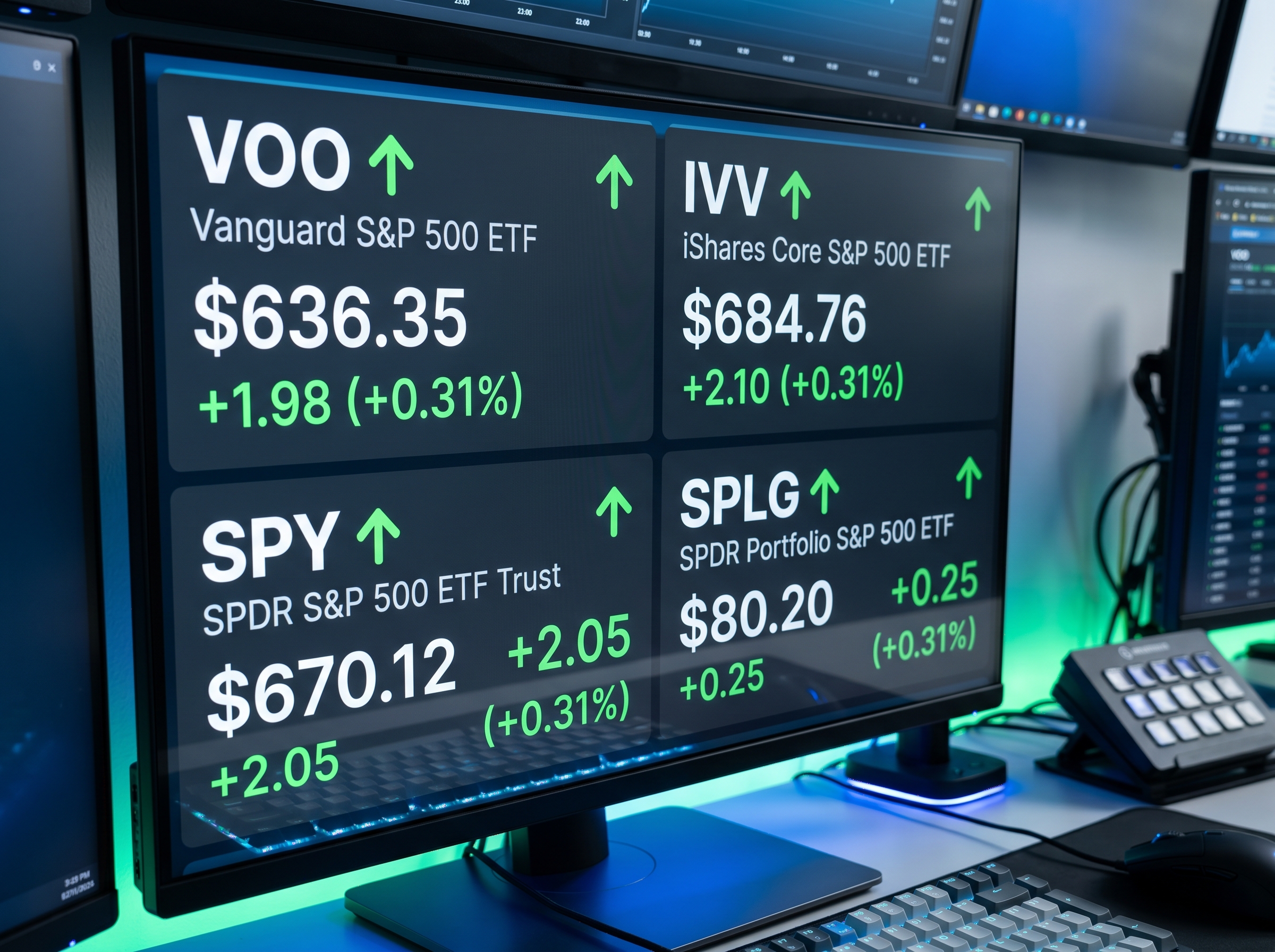
ETF Ticker Expense Ratio AUM (April 2026) Share Price (approx.) Best For Vanguard S&P 500 ETF VOO 0.03% ~$1.4 trillion ~$520 Long-term buy-and-hold investors iShares Core S&P 500 ETF IVV 0.03% ~$774 billion ~$570 Long-term investors, brokerage flexibility SPDR S&P 500 ETF Trust SPY 0.0945% ~$703 billion ~$550 Active traders, options strategies SPDR Portfolio S&P 500 ETF SPLG 0.02% Growing rapidly ~$65 Small accounts, lowest-cost entry point
Expense ratios and approximate share prices as of April 2026. AUM figures sourced from iShares, Vanguard, and State Street fund pages. Share prices fluctuate daily.
SPLG is the most affordable option in the entire category at 0.02% — costing $2 per year on a $10,000 investment, compared to $3 for VOO or IVV and $9.45 for SPY. Its lower share price (~$65) also makes it accessible for investors with smaller starting balances who want to invest whole-share amounts without fractional trading. Asset growth in SPLG has accelerated significantly over the past two years as cost-conscious investors have discovered it.
VOO from Vanguard is the world's largest S&P 500 ETF, having reached approximately $1.4 trillion in assets under management by April 2026. Its scale drives razor-thin bid-ask spreads and deep liquidity for retail investors. Vanguard's unique ownership structure — where fund investors effectively own the management company — creates a structural incentive to keep costs low over time.
IVV from BlackRock's iShares is functionally interchangeable with VOO for most investors. At $774 billion in AUM, it is the second-largest S&P 500 ETF and trades freely across all major US brokerages with no commissions. If your brokerage gives IVV preferential treatment — some platforms integrate it more fully into their portfolio tools — it makes an equally sound choice.
SPY is the original US-listed ETF, launched in 1993, and it remains the most heavily traded security in the world with approximately $62 billion in average daily dollar volume. That liquidity makes it the only choice for investors who trade options on S&P 500 ETFs, where SPY's options market dwarfs those of VOO and IVV combined. For passive, long-term buy-and-hold investors, however, SPY's higher expense ratio (0.0945% vs. 0.03%) represents a meaningful cumulative cost for no additional benefit.
VOO vs. IVV vs. SPY vs. SPLG: Which Should You Choose?
The most important structural difference in this group is between SPY and the other three. SPY operates as a Unit Investment Trust (UIT) — a legacy structure from 1993 that, by law, cannot reinvest dividends paid by underlying holdings back into the fund. Those dividends accumulate in a non-interest-bearing cash account until the quarterly distribution date. During strong market periods, this cash drag reduces SPY's total return marginally compared to VOO and IVV, which are open-end funds that reinvest dividends immediately and can engage in securities lending for additional income.
For most investors, the practical choice is binary: SPLG if you are starting with a smaller account and want the absolute lowest cost per share, or VOO/IVV for larger accounts where the share price is irrelevant and either fund performs identically. Flip a coin between VOO and IVV — the long-run performance difference between the two is measured in fractions of a basis point and will not affect your financial outcomes in any meaningful way.
Choose SPY only if you trade options or need the deepest intraday liquidity for short-term strategies. Its options market is the most liquid financial derivatives market in the world, which matters if you write covered calls or use protective puts. For everyone else, paying three times the expense ratio for the same underlying index exposure is an unnecessary cost.
Pro Tip: The 10-year cost difference between SPLG (0.02%) and SPY (0.0945%) on a $100,000 portfolio growing at 10% annually is approximately $2,400 in additional fees paid to SPY — money that would otherwise remain in your account, compounding. Expense ratios are not small numbers at scale. Choose the cheapest fund that meets your needs.
How to Start Investing in S&P 500 ETFs: Step by Step
Open a brokerage account. Fidelity, Schwab, and Vanguard all offer commission-free ETF trading with no account minimums. If you want fractional shares — useful for investing exact dollar amounts in higher-priced ETFs like VOO — Fidelity and Schwab both support this. Robinhood and M1 Finance are popular options for mobile-first investors who want fractional investing with a simpler interface.
Choose a tax-advantaged account first. If you are in the US, maximize contributions to a Roth IRA ($7,000 annual limit in 2026, $8,000 if you are 50 or older) or a Traditional IRA before investing in a taxable brokerage account. Capital gains and dividends inside a Roth IRA grow entirely tax-free — the most powerful compounding environment available to individual investors. If your employer offers a 401(k) match, capture that match before any other investment: it is an immediate 50-100% return on your contribution.
Select your ETF. For most investors starting in 2026: SPLG if your account balance is below $10,000 and share price matters, VOO or IVV for everything else. Search the ticker in your brokerage's trading interface, verify you are viewing the correct fund (check the CUSIP or full fund name), and confirm the exchange is NYSE Arca for all four funds.
Set up automatic contributions. The single most powerful behavior in long-term investing is not stock selection — it is consistent, regular contributions regardless of market conditions. Dollar-cost averaging (investing a fixed amount monthly) removes the psychological burden of trying to time the market and ensures you buy more shares when prices are lower. Most brokerages support automated monthly investments directly into ETFs.
Reinvest dividends. Enable automatic dividend reinvestment (DRIP) in your brokerage settings. S&P 500 ETFs typically yield around 1.1% in annual dividends — a modest figure that compounds meaningfully over decades when reinvested. On a $500,000 portfolio, that is $5,500 per year going back to work for you automatically.
S&P 500 ETFs for UK, Canadian, and Australian Investors
US-listed ETFs like VOO and IVV are accessible to international investors but come with withholding tax complications and currency considerations. Each Tier 1 market has developed local solutions that address these issues.
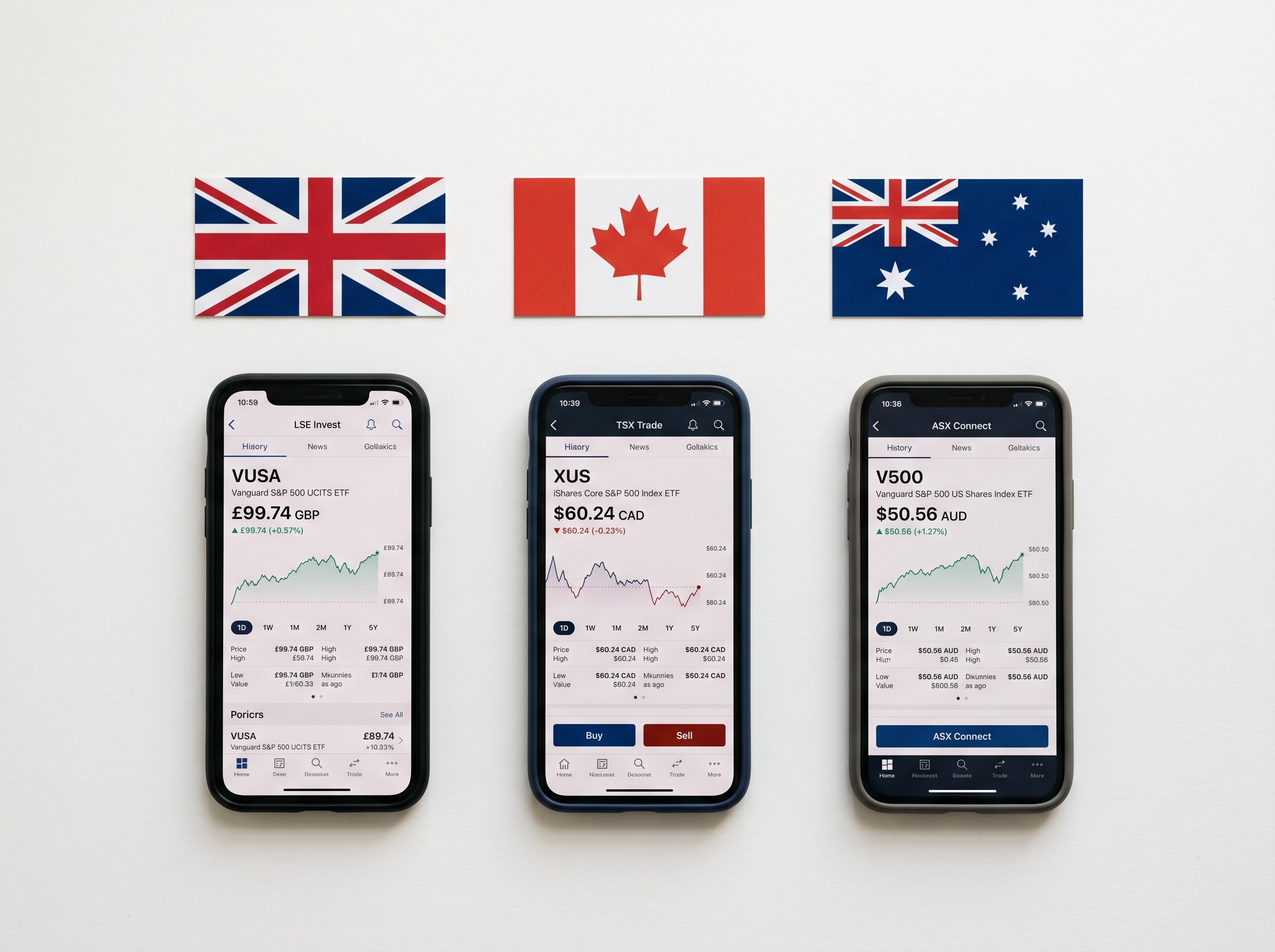
United Kingdom: UK investors cannot hold US-listed ETFs like VOO inside a Stocks and Shares ISA due to PRIIPS regulations, which prohibit the distribution of ETFs without a compliant Key Information Document. The practical alternatives are Ireland-domiciled equivalents listed on the London Stock Exchange. CSPX (iShares Core S&P 500 UCITS ETF, accumulating) and VUSA (Vanguard S&P 500 UCITS ETF, distributing) both charge a 0.07% Total Expense Ratio and trade in GBP on the LSE. Ireland's favorable tax treaty with the US reduces withholding tax on US dividends to 15% at the fund level — better than the 30% faced by UK-domiciled alternatives. Both are fully ISA-eligible, shielding all capital gains and income from UK taxation for annual contributions up to £20,000.
Canada: Canadian investors have two practical routes for S&P 500 exposure. The Vanguard S&P 500 Index ETF (VFV) trades on the Toronto Stock Exchange in Canadian dollars and is the most popular domestic option for TFSA and non-registered accounts, with a management expense ratio of 0.09%. For RRSP accounts specifically, holding the US-listed VOO directly on the NYSE eliminates the 15% dividend withholding tax that applies to Canadian-domiciled US equity ETFs — a meaningful tax advantage on large registered accounts. XSP (iShares Core S&P 500 Index ETF, CAD-hedged) is available at an MER of 0.09% for investors who want Canadian dollar exposure without currency risk, though the hedging cost reduces long-run returns modestly. RRSP contribution limits are C$32,490 in 2026, and unused contribution room from prior years carries forward.
Australia: The ASX-listed IVV (iShares S&P 500 ETF, not to be confused with the US ticker) tracks the S&P 500 directly and carries a management fee of 0.04% per year — the lowest-cost S&P 500 ETF available on the ASX, with over A$5 billion in AUM. For broader US market exposure beyond the S&P 500, VTS (Vanguard US Total Market Shares Index ETF) tracks over 3,500 US companies at a similarly low cost. Australian investors should be aware that S&P 500 ETFs held outside superannuation are subject to standard CGT rules — assets held for more than 12 months qualify for the 50% CGT discount. Inside a super fund, the tax rate on earnings is 15% (and zero in pension phase), making super the most tax-efficient vehicle for long-term US equity exposure.
Frequently Asked Questions
Q: Is it too late to invest in the S&P 500 after years of strong returns?
This question has been asked every year since the S&P 500 was created — and the historical answer is consistently no. Over any rolling 20-year period in the S&P 500's history, the index has never delivered a negative return. Attempting to time a market entry around perceived overvaluation has historically been more costly than simply investing and waiting. The best time to start is when you have money to invest; the second best time is as soon as possible after that.
Q: What is the difference between an ETF and an index fund?
Both track the same index and produce nearly identical returns, but they differ in how they trade. ETFs like VOO and IVV trade on stock exchanges throughout the day at market prices, like individual stocks. Index mutual funds (like Fidelity's FXAIX) price once per day after the market closes and can only be bought or sold at that day's closing price. For most long-term investors, the practical difference is minimal. ETFs have a slight tax efficiency advantage in taxable accounts; index mutual funds allow exact dollar-amount investments without fractional share support.
Q: How much should I invest in S&P 500 ETFs each month?
Any consistent amount is better than nothing. A $200 monthly investment in a low-cost S&P 500 ETF, compounding at the historical average of 10% annually, grows to approximately $152,000 over 20 years and $418,000 over 30 years — entirely from $200 monthly contributions. The math of compound interest rewards consistency and time more than it rewards starting amount. For practical benchmarking: most financial planners suggest directing 15% of gross income toward long-term investments, prioritizing tax-advantaged accounts (401k, Roth IRA, ISA, RRSP, super) before taxable brokerage accounts.
Q: What are the risks of S&P 500 ETFs?
The primary risks are concentration, sequence-of-returns risk, and currency risk for non-US investors. Concentration: the S&P 500 is market-cap-weighted, meaning the top ten companies — almost all large-cap technology firms — account for roughly one-third of the index. A prolonged downturn in tech would disproportionately affect returns. Sequence-of-returns risk: a major market decline in the early years of retirement can permanently impair a portfolio even if long-run returns are positive. Currency risk: for UK, Canadian, and Australian investors holding US-listed ETFs, a weakening US dollar reduces returns when converted back to home currency.
Q: How do dividends work with S&P 500 ETFs?
S&P 500 ETFs collect dividends paid by the 500 underlying companies and distribute them to ETF shareholders on a quarterly basis. The annual dividend yield for VOO, IVV, and SPY is approximately 1.1% as of April 2026. In a Roth IRA or ISA, these dividends are reinvested tax-free. In a taxable account, they are typically taxed as qualified dividends at the lower long-term capital gains rate (0%, 15%, or 20% in the US, depending on income). Accumulating share-class ETFs available in the UK and EU automatically reinvest dividends within the fund, avoiding the need for manual reinvestment and delaying the tax event.
The Bottom Line
The evidence for low-cost S&P 500 index investing has never been stronger. With only 8% of professional large-cap stock pickers beating a simple index fund over the past decade, paying active management fees is not a bet most investors should take. The best S&P 500 ETFs of April 2026 — VOO, IVV, SPLG, and SPY for specific use cases — all provide access to the same 500 companies. The decision between them comes down to your account size, whether you trade options, and your brokerage preference.
Once your S&P 500 foundation is in place, consider broadening your picture. A solid emergency fund — earning 4 to 5% in a high-yield savings account — should exist before any investment account. And as your net worth grows, reviewing your life insurance coverage ensures that the wealth you are building is protected against the unexpected. Invest consistently, keep costs minimal, and let compounding do the work.
Disclaimer: This article is for informational purposes only and does not constitute personalized financial, investment, legal, or tax advice. Past performance is not a guarantee of future results. Always consult a qualified financial professional before making investment decisions.
Sources
Morningstar. "Active vs. Passive Investing: Which Categories Are More Successful?" Morningstar, 2025. Link
CNBC. "Fewer Active Managers Beat Index Funds Last Year." CNBC, February 2026. Link
Macrotrends. "S&P 500 Historical Annual Returns (1927–2026)." Macrotrends, 2026. Link
NerdWallet. "The Top S&P 500 ETFs for April 2026: IVV, VOO and More." NerdWallet, April 2026. Link
Mezzi. "SPLG vs VOO vs IVV: Cheapest S&P 500 ETF for Small Accounts." Mezzi, 2026. Link
Investment Company Institute. "Active and Index Investing, February 2026." ICI, 2026. Link
The Investors Centre. "How UK Investors Can Invest in the S&P 500 (2026 Guide)." The Investors Centre, 2026. Link
The Motley Fool Canada. "Top S&P 500 ETFs in Canada 2026." The Motley Fool Canada, 2026. Link
Selfwealth. "ETFs Head-to-Head: iShares IVV vs BetaShares NDQ vs Vanguard VTS." Selfwealth, 2026. Link
TrendSpider. "SPY vs VOO vs IVV: Best S&P 500 ETF Comparison 2026." TrendSpider, 2026. Link