Best High-Yield Savings Accounts 2026: Earn Up to 5% APY
67% of savers earn under 4% APY while top accounts pay 5.00%. Discover the best high-yield savings accounts of April 2026 and maximize your money today.

Key Takeaways
The best high-yield savings accounts in April 2026 offer up to 5.00% APY — more than 8x the national average of 0.59%.
67% of American savers currently earn below 4% APY, according to Bankrate's 2026 survey, even as top accounts pay far more.
The Federal Reserve held its benchmark rate at 3.50%–3.75% on March 18, 2026, keeping competitive savings rates elevated for now.
24% of Americans have zero emergency savings — making a high-yield account the single most impactful financial move available today.
UK, Canadian, and Australian savers also have strong options, with rates reaching 5.65% in Australia and 4.60% in Canada for new accounts.
Here is a number worth sitting with: 67% of Americans with savings accounts are earning less than 4% APY right now, according to Bankrate's April 2026 survey — even as the top accounts on the market pay 5.00%. Put another way, if you have $20,000 in a standard bank savings account paying the national average of 0.59%, you will earn roughly $118 this year. Move that same $20,000 to a leading high-yield savings account and you pocket closer to $1,000. Same money. Same FDIC protection. Dramatically different result.
The gap has never been easier to close. Online banks and fintech lenders now offer accounts with no minimum balance, no monthly fees, and full government deposit insurance — yet millions of savers have not made the switch. Bankrate's 2026 Emergency Savings Report found that 24% of Americans have no emergency savings at all, and the US personal savings rate fell to just 4.5% of disposable income in January 2026, well below the historical average of 8.4%. The cost of inaction compounds quietly every single month.
This guide covers the best high-yield savings accounts available in April 2026, explains how rates are likely to move through the rest of the year, and gives savers in the US, UK, Canada, and Australia a clear picture of what to do today to make their cash work meaningfully harder.
What Is a High-Yield Savings Account and Why It Matters in 2026
A high-yield savings account (HYSA) is a deposit account — typically offered by online banks, credit unions, or fintech companies — that pays a significantly higher annual percentage yield than the accounts most traditional brick-and-mortar banks offer. Where a conventional bank might pay 0.01% to 0.10% APY, a competitive HYSA in April 2026 pays between 4% and 5% APY on the same type of fully liquid, government-insured balance.
The elevated rates trace directly back to the Federal Reserve. After raising its benchmark federal funds rate aggressively from 2022 through 2024 to bring down inflation, the Fed now holds its target range at 3.50%–3.75% — a level it maintained without change at its most recent meeting on March 18, 2026. Online banks, which carry far lower overhead costs than their branch-heavy competitors, pass more of that rate environment on to depositors as a way of attracting and retaining customers. Traditional banks, under less competitive pressure, generally do not.
The window may not stay open indefinitely. Ted Rossman, senior industry analyst at Bankrate, projects that the highest nationally available savings account rate will settle around 3.70% APY by the end of 2026 as the Fed eventually resumes cutting rates. That forecast makes April 2026 a particularly compelling time to open — or switch to — a high-yield account and lock in a multi-year high on fully liquid cash.
"The highest nationally available savings and money market account rate will be around 3.70% APY at the end of 2026 — down over 100 basis points from the top rates seen in 2025." — Ted Rossman, Senior Industry Analyst, Bankrate, 2026
Best High-Yield Savings Accounts of April 2026
The accounts below were selected based on APY, fee structure, minimum balance requirements, FDIC or NCUA insurance status, and broad availability across the US. All rates are as of April 2026 and can change without notice — verify directly with the provider before opening.
Account APY Min. Balance Monthly Fee Best For Varo High-Yield Savings 5.00% $0 $0 Balances up to $5,000 with direct deposit Pibank Savings 4.60% $0 $0 Any balance, zero conditions Axos Bank High-Yield Savings 4.21% $0 $0 Full-featured online banking Newtek Bank Personal HYSA 4.20% $0 $0 Simple no-conditions savings Vio Bank High-Yield Savings 4.03% $0 $0 Larger balances at an established bank
Data as of April 2026. Rates subject to change. Varo's 5.00% APY applies to balances up to $5,000 and requires qualifying monthly direct deposit activity. Always verify current rates directly with each provider. Sources: Bankrate, Fortune, NerdWallet, April 2026.
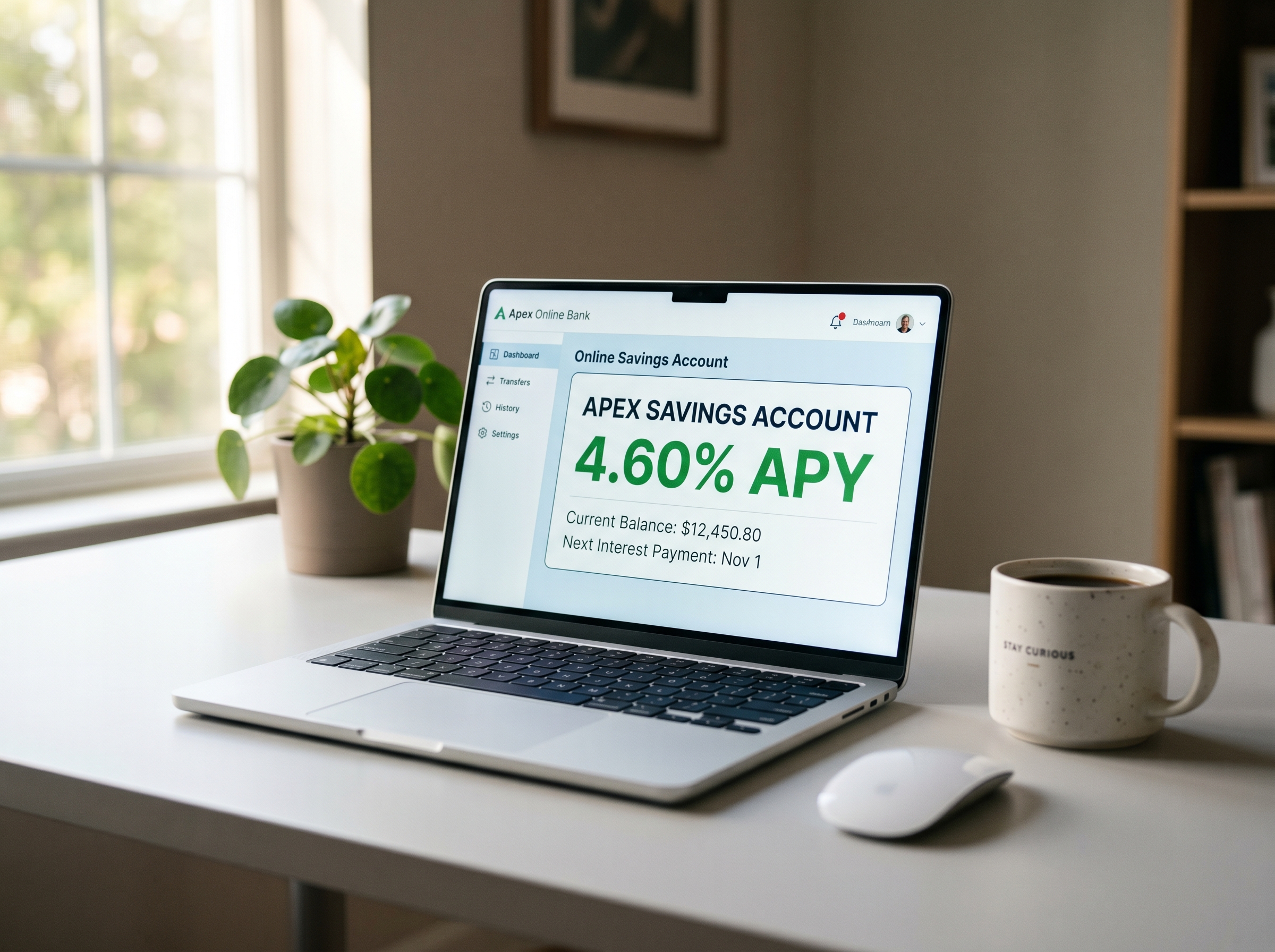
Varo leads the field with a 5.00% APY on balances up to $5,000, though meeting the qualifying direct deposit and spending thresholds is required. For savers whose emergency fund sits below that $5,000 cap and who already use direct deposit, Varo is genuinely hard to beat. Pibank earns the top spot for simplicity: 4.60% APY with no balance caps, no bonus hurdles, and no monthly fees — the rate you see is the rate you get. Axos and Newtek both hover just above 4.20% and are strong choices for savers who want a broader banking relationship alongside their high-yield account. Vio Bank is worth considering for larger balances at a well-established institution with a long track record.
How to Open and Maximize Your High-Yield Savings Account
Opening a high-yield savings account takes under ten minutes for most people, but using one strategically over years is what separates savers who build real financial cushions from those who merely intend to. Here is a five-step process that works:
Set a concrete savings target first. — The standard personal finance benchmark is three to six months of essential living expenses kept in a fully liquid account. If your monthly fixed costs run $3,500, you want between $10,500 and $21,000 in your HYSA. Savings beyond that floor may be better deployed in longer-term vehicles such as CDs, index funds, or retirement accounts.
Read the fine print on rates and conditions. — A headline rate of 5.00% APY means nothing if the qualifying conditions are difficult to meet. Before opening, confirm whether the advertised APY requires a minimum monthly direct deposit, a minimum number of debit card transactions, or applies only up to a balance ceiling. Pibank's 4.60% and Newtek's 4.20% both require no conditions and are the cleanest options for most savers.
Apply online with basic documents ready. — You will need a government-issued photo ID, your Social Security Number (or equivalent), and your existing bank account details for the initial funding transfer. Most online banks approve applications within minutes and complete the account-linking process within one to three business days.
Automate your contributions from day one. — Schedule a recurring transfer from your checking account on the same day your paycheck arrives, even if the amount starts small. Depositing $300 per month into a 4.60% APY account generates roughly $690 in interest over two years from automation alone — before any rate compounding or balance growth.
Review your rate every six months. — HYSA rates move with Federal Reserve policy. An account that leads the market in April 2026 may have slipped by October. Set a calendar reminder to benchmark your rate against current competitors twice a year and switch if a meaningful gap has opened up.
Pro Tip: Open your HYSA at a different bank from your primary checking account. The mild friction of a two-day transfer makes you far less likely to dip into emergency savings for everyday purchases — a behavioral design principle that financial planners consistently recommend for building lasting savings habits.
HYSA vs. Money Market Accounts vs. CDs: Which Fits Your Goal?
High-yield savings accounts are not the only tool for cash you want to keep safe and accessible. Understanding how they compare to money market accounts and certificates of deposit helps you allocate savings to the right vehicle for each goal you have.
Money market accounts (MMAs) are structurally very close to HYSAs — both are FDIC-insured, both pay competitive APYs, and both allow withdrawals without penalty. The practical differences tend to come down to account features: MMAs sometimes include check-writing privileges and a linked debit card, but may carry higher minimum balance requirements to earn the top rate. In April 2026, leading money market rates are broadly in line with top HYSA rates, so the choice between the two usually comes down to whether you want debit access rather than which pays more.
Certificates of deposit (CDs) offer a fundamentally different trade-off. A 12-month CD from a competitive online bank currently yields between 4.50% and 5.00% APY — comparable to the best HYSAs — but your principal is locked in for the full term. Withdraw early and you pay a penalty, typically equal to three to six months of interest. CDs are the right tool when you have savings you know you will not need for a defined period — a home deposit you plan to use in 12 months, for example, or cash you want to shelter from rate cuts that are likely by year-end. For an emergency fund that must remain fully and immediately accessible, a HYSA is the better choice every time.
Important: Bankrate projects that top CD and HYSA rates will trend lower through the second half of 2026 as the Federal Reserve is expected to resume rate cuts. If locking in today's rates matters to you, opening a 12-month CD now — alongside a liquid HYSA for your emergency fund — gives you the best of both worlds.
Savings Rates in the UK, Canada, and Australia: Best Options in 2026
US-style high-yield savings accounts do not map directly to every Tier 1 market, but equivalent — and in some cases superior — options exist for savers in the UK, Canada, and Australia.
United Kingdom: British savers work within a different product framework but have access to strong rates through challenger banks and building societies. In April 2026, Nationwide Building Society's FlexDirect account pays 5.00% AER on balances up to £1,500, while LHV Bank's standard current account offers 3.75% AER on balances up to £1 million. For tax efficiency, the Cash ISA allows up to £20,000 per year in fully tax-sheltered interest — a wrapper worth prioritizing before holding funds in a standard savings account, since interest earned above the Personal Savings Allowance (£500 for basic-rate taxpayers, £0 for additional-rate taxpayers) is taxable. Deposits at UK-authorised institutions are protected up to £85,000 per person under the Financial Services Compensation Scheme (FSCS), regulated by the FCA.
Canada: Canadian savers have access to one of the most powerful tax-sheltered savings vehicles in any Tier 1 country — the Tax-Free Savings Account (TFSA). The annual contribution limit remains $7,000 CAD in 2026, and cumulative lifetime room has grown to $109,000 for those eligible since 2009. Tangerine currently offers a promotional TFSA rate of 4.60% for the first five months for new clients. EQ Bank offers a standard everyday TFSA rate of 1.50% with no conditions, while Pathwise's TFSA GIC pays 5.00% on a 12-month term for savers willing to lock in. First-time buyers should also explore the First Home Savings Account (FHSA), which combines RRSP-style tax deductibility on contributions with TFSA-style tax-free withdrawals on qualifying home purchases. CDIC member institutions protect deposits up to $100,000 CAD per depositor per category.
Australia: The Reserve Bank of Australia raised its cash rate to 4.10% in early 2026 — its second consecutive hike — and savings account rates have responded. Rabobank Australia's High Interest Savings Account leads the market with a 5.65% introductory rate for the first four months, reverting to 3.95% thereafter. For ongoing rates with no introductory conditions, AMP Bank's GO Save account offers 4.85% p.a. on balances up to $500,000 AUD. Australian savers under 30 should look at Westpac's Life account, which pays an ongoing 5.50% bonus rate for account holders who grow their balance month-on-month and make at least 20 purchases per month. Deposits at authorised deposit-taking institutions are guaranteed up to $250,000 AUD under the Financial Claims Scheme (FCS), administered by APRA.
Frequently Asked Questions
Q: Is my money safe in a high-yield savings account?
Yes — provided you choose an account at an FDIC-insured bank or NCUA-insured credit union. The federal government guarantees deposits up to $250,000 per depositor, per institution, per account ownership category in the event of a bank failure. This is identical protection to what standard savings accounts carry at any US bank, regardless of how high the APY is.
Q: Will high-yield savings rates keep falling through 2026?
Most analysts expect a gradual decline. The Federal Reserve held its target rate at 3.50%–3.75% in March 2026, and a rate cut is not widely expected before mid-year at the earliest. Bankrate's Ted Rossman forecasts the top nationally available HYSA rate will land near 3.70% APY by December 2026 — still a substantial advantage over traditional bank accounts but meaningfully lower than today's 5.00% peak.
Q: How many high-yield savings accounts can I open?
There is no legal limit. Many financially organized households maintain two or three — one for an emergency fund, one for a specific near-term goal such as a home purchase or car replacement, and sometimes one for a tax or annual bill reserve. The only practical constraint is ensuring total deposits at any single institution remain within the $250,000 FDIC insurance limit.
Q: Is the interest on a HYSA taxable?
In the US, yes. Interest earned in a standard high-yield savings account is classified as ordinary income by the IRS and taxed at your marginal rate in the year it is earned. Your bank will issue a 1099-INT form if you earn $10 or more in interest during the calendar year. To shelter savings interest from tax, a Roth IRA (for retirement-oriented savings) or a Health Savings Account (for medical funds) are the primary options available to US residents.
Q: What is the difference between APY and APR on a savings account?
APY (Annual Percentage Yield) accounts for the compounding of interest — meaning interest earned on previously credited interest — whereas APR (Annual Percentage Rate) does not. For savings accounts, APY is the number that matters because it reflects what you will actually earn across a full year. An account paying 4.50% APR with monthly compounding has an effective APY of approximately 4.59%.
The Bottom Line
The spread between what most people earn on their savings and what they could earn has rarely been this wide — or this simple to eliminate. With FDIC-insured accounts paying up to 5.00% APY in April 2026, there is no compelling reason to leave an emergency fund in a traditional account earning 0.59%. Opening a high-yield savings account costs nothing, takes ten minutes, and generates hundreds of extra dollars per year on a typical balance.
Start by calculating three to six months of essential expenses as your target balance. Choose an account with no fees and no opaque qualifying conditions — Pibank's 4.60% or Newtek's 4.20% are both clean, competitive picks. Set up an automatic monthly transfer and let compounding do its work. Once your emergency fund is fully funded, explore how to put the rest of your money to work through our guides to low-cost index fund investing or learn how certificates of deposit can lock in today's rates before the Fed cuts further.
Disclaimer: This article is for informational purposes only and does not constitute personalized financial, investment, legal, or tax advice. Always consult a qualified financial professional before making major financial decisions.
Sources
Bankrate. "Best High-Yield Savings Accounts of April 2026." Bankrate, April 2026. Link
Bankrate. "Average Savings Account Interest Rate for April 2026." Bankrate, April 2026. Link
Bankrate. "Bankrate's 2026 Emergency Savings Report." Bankrate, 2026. Link
Bankrate. "Survey: Two-Thirds of Savers Still Earn a Savings Account APY of Less Than 4%." Bankrate, 2026. Link
Bankrate. "Savings and Money Market Account Rates Forecast for 2026." Bankrate, 2026. Link
Fortune. "Top High-Yield Savings Rates: Up to 5.00% on April 17, 2026." Fortune, April 2026. Link
Federal Reserve. "Report on the Economic Well-Being of U.S. Households in 2024." Federal Reserve, May 2025. Link
Canstar. "Best High Interest Savings Accounts Australia 2026." Canstar, April 2026. Link
MoneySense. "The Best TFSAs in Canada for 2026." MoneySense, 2026. Link
Good Money Guide. "Best High Interest-Paying Savings Accounts April 2026." Good Money Guide, April 2026. Link