Best AI Personal Finance Apps of 2026
AI finance tool adoption jumped from 10% to 55% of Americans in one year. Compare the best AI budgeting apps and robo-advisors of April 2026.

Key Takeaways
55% of Americans now use AI tools to aid financial management decisions — up from just 10% a year ago, according to a 2026 TD Bank and Ipsos survey.
The global robo-advisory market is projected to reach $44.97 billion in assets under management by 2026, growing from $16.51 billion in 2022.
AI budgeting apps range from free (Empower, Cleo's basic tier) to $14.99 per month (YNAB), with robo-advisors typically charging 0.25% of assets annually.
90% of consumers who acted on AI-generated financial suggestions reported those ideas were profitable or worthwhile — but most still want a human to make final calls.
The best AI finance tool depends on your goal: budgeting apps work best for day-to-day spending control, while robo-advisors handle long-term wealth building.
One year ago, just 10% of consumers reported using AI to help manage their personal finances. By early 2026, that figure has jumped to 55% — a fivefold increase driven by the rapid mainstreaming of generative AI and the arrival of a new generation of genuinely intelligent money apps. Among Gen Z adults, the adoption rate has already reached 77%. AI is no longer a novelty on top of a spreadsheet. For millions of people, it has become the primary interface for understanding where their money goes.
This matters because the tools themselves have improved dramatically. Earlier AI finance apps offered little more than transaction categorization. The 2026 generation can analyze your spending patterns, flag subscription creep before it drains your account, rebalance your investment portfolio automatically, answer real questions about your financial situation in plain language, and project your net worth decades into the future — all without a financial advisor's hourly fee. The Global AI in Fintech market is expected to reach approximately $20.6 billion in 2026, and competition is forcing every major platform to accelerate its AI capabilities.
This guide covers the best AI personal finance apps and robo-advisors of April 2026, how they compare on price and features, what tools work best outside the US in the UK, Canada, and Australia, and what real risks to watch for before handing your budget to an algorithm.
What AI Personal Finance Tools Can Actually Do in 2026
Understanding what these tools genuinely do — versus what their marketing implies — saves you from paying for features that don't match how you actually manage money. There are three distinct categories of AI in personal finance right now, and they solve very different problems.
AI budgeting and spending tools connect to your bank accounts and credit cards, read your transaction history, and use machine learning to categorize, analyze, and surface insights about your spending. The best ones in 2026 do this with growing accuracy — Copilot Money's categorization engine, for example, learns from user corrections and improves over time. These tools help you see patterns you would otherwise miss: that your food delivery spending increased 40% over three months, that you have four active streaming subscriptions, or that your utility bills spike every January.
AI robo-advisors automate investment portfolio management. You answer questions about your risk tolerance and time horizon, deposit money, and the platform builds and maintains a diversified portfolio of low-cost index funds or ETFs. The AI handles rebalancing when your allocation drifts, applies tax-loss harvesting strategies to reduce your capital gains exposure, and adjusts to market movements without requiring any action from you. Betterment and Wealthfront are the two dominant platforms in the US, both charging a 0.25% annual management fee.
AI financial assistants and chatbots let you ask natural-language questions about your money: "How much did I spend on restaurants last month compared to the month before?" or "Am I on track to pay off my credit card by December?" Wealthsimple's AI chatbot, for instance, can now accurately answer 60 to 70% of customer financial questions without human intervention, according to the company's 2026 update. Cleo takes a different approach, combining a conversational chatbot with behavioral coaching to make personal finance feel less intimidating for users who tend to avoid checking their accounts.
"More than half of respondents said they use AI to aid their financial management decisions — with adoption rates highest among Gen Z at 77% and Millennials at 72%. Nearly all who acted on AI suggestions said those ideas were profitable or worthwhile." — Ipsos/TD Bank AI and Finance Survey, 2026
Best AI Budgeting Apps of April 2026
These five platforms represent the current state of the art in AI-powered personal budgeting. Each targets a slightly different type of user — the comparisons below should help you identify which fits your financial habits.
App Monthly Cost AI Depth Platform Best For Copilot Money $7.92 (annual) / $13 (monthly) Very High iOS, Mac only Apple users who want the best AI categorization Monarch Money $8.33 (annual) / $14.99 (monthly) High iOS, Android, Web Couples, shared finances, net worth tracking YNAB $8.25 (annual) / $14.99 (monthly) Low (manual focus) iOS, Android, Web Debt payoff, zero-based budgeters Cleo Free / $5.99 (Plus) High (conversational) iOS, Android Beginners, Gen Z, habit coaching Empower Free Medium iOS, Android, Web Net worth tracking, investment overview
Pricing as of April 2026. Sources: CostBench, app official pricing pages.
Copilot Money currently holds the most sophisticated behavioral AI of any consumer budgeting app. Its machine learning categorization engine adapts to corrections over time, meaning the longer you use it, the more accurate it becomes at understanding your spending in context — distinguishing between a business lunch and a personal dinner at the same restaurant, for example. The significant limitation is platform exclusivity: Copilot runs only on iOS and Mac, making it unavailable to Android and Windows users.
Monarch Money is the strongest cross-platform option and the top choice for couples. Its shared dashboard allows partners to track joint and individual accounts simultaneously, set collaborative savings goals, and review spending together without awkward spreadsheet-sharing. Monarch's AI assistant answers questions about your financial trends and delivers a weekly recap that summarizes major money shifts — useful for busy households that want oversight without daily check-ins.
YNAB stands apart because it is fundamentally a methodology app, not an AI app. Its zero-based budgeting approach — every dollar assigned a purpose before it's spent — has a proven track record for users tackling debt, but it requires active, daily engagement that not everyone maintains. YNAB's AI features as of 2026 remain limited compared to Copilot or Monarch. Choose YNAB if the discipline of zero-based budgeting appeals to you; choose something else if you want passive, automated insight.
Cleo takes the most unusual approach in the category. Rather than dashboards and graphs, Cleo presents your finances through a conversational AI chatbot that gives blunt, sometimes witty feedback on your spending habits. It alerts you when you're approaching budget limits, helps set savings goals, and can roast you gently when you overspend on takeout. For users who find traditional finance apps intimidating or boring, Cleo's engagement model makes checking your finances feel less like a chore.

Best AI Robo-Advisors of 2026
If budgeting apps help you control where your money goes today, robo-advisors put your long-term wealth building on autopilot. These platforms use algorithms to build and manage diversified investment portfolios — replacing what a traditional human financial advisor would charge 1% or more annually to do — at a fraction of the cost.
Wealthfront — Best Overall Robo-Advisor. Wealthfront charges 0.25% annually with no account minimum for its automated investing product. NerdWallet rates it as the top pick for portfolio options in 2026, thanks to its wide variety of account types (individual, joint, IRA, 529 college savings, trust), automated tax-loss harvesting, and a separate stock investing account with fractional shares and zero commissions. Wealthfront's Path financial planning tool projects long-term scenarios for retirement, home purchase, and college funding using your actual linked account data.
Betterment — Best for Goal-Based Investing. Betterment charges 0.25% per year for its digital tier (with a $4/month fee for balances under $20,000) and offers a premium tier with access to human financial advisors at 0.65%. Its strength is goal-based portfolio construction — you set specific targets (retirement at 65, down payment in five years, travel fund) and Betterment builds separate, optimized portfolios for each goal. Tax-loss harvesting and automatic rebalancing are included at the base tier.
Schwab Intelligent Portfolios — Best Free Option. Schwab charges zero management fees — no percentage, no monthly fee — for its automated investing product, though it requires a $5,000 minimum balance and keeps a portion of your portfolio in cash. For investors with at least $5,000 to commit who prefer no ongoing fee, Schwab's offering is compelling. It includes automatic rebalancing and access to 51 ETFs spanning US equities, international equities, fixed income, real estate, and commodities.
Fidelity Go — Best for Beginners with Small Balances. Fidelity Go charges no advisory fee for accounts under $25,000 — making it the most accessible robo-advisor for savers just starting out. Above $25,000, a flat $3/month fee applies. Fidelity invests exclusively in its own zero-expense-ratio mutual funds, keeping underlying fund costs at zero and making the total cost of ownership among the lowest in the category.
Pro Tip: Robo-advisors and AI budgeting apps serve different functions and are not mutually exclusive. Many financially organized households use a budgeting app (Copilot or Monarch) for day-to-day spending awareness and a robo-advisor (Wealthfront or Betterment) for automated long-term investing. The two tools complement rather than replace each other.
AI Finance Tools for UK, Canada, and Australia
The AI personal finance revolution is not limited to the US. Each Tier 1 market has developed its own set of leading tools, shaped by local regulatory environments, tax structures, and banking infrastructure.
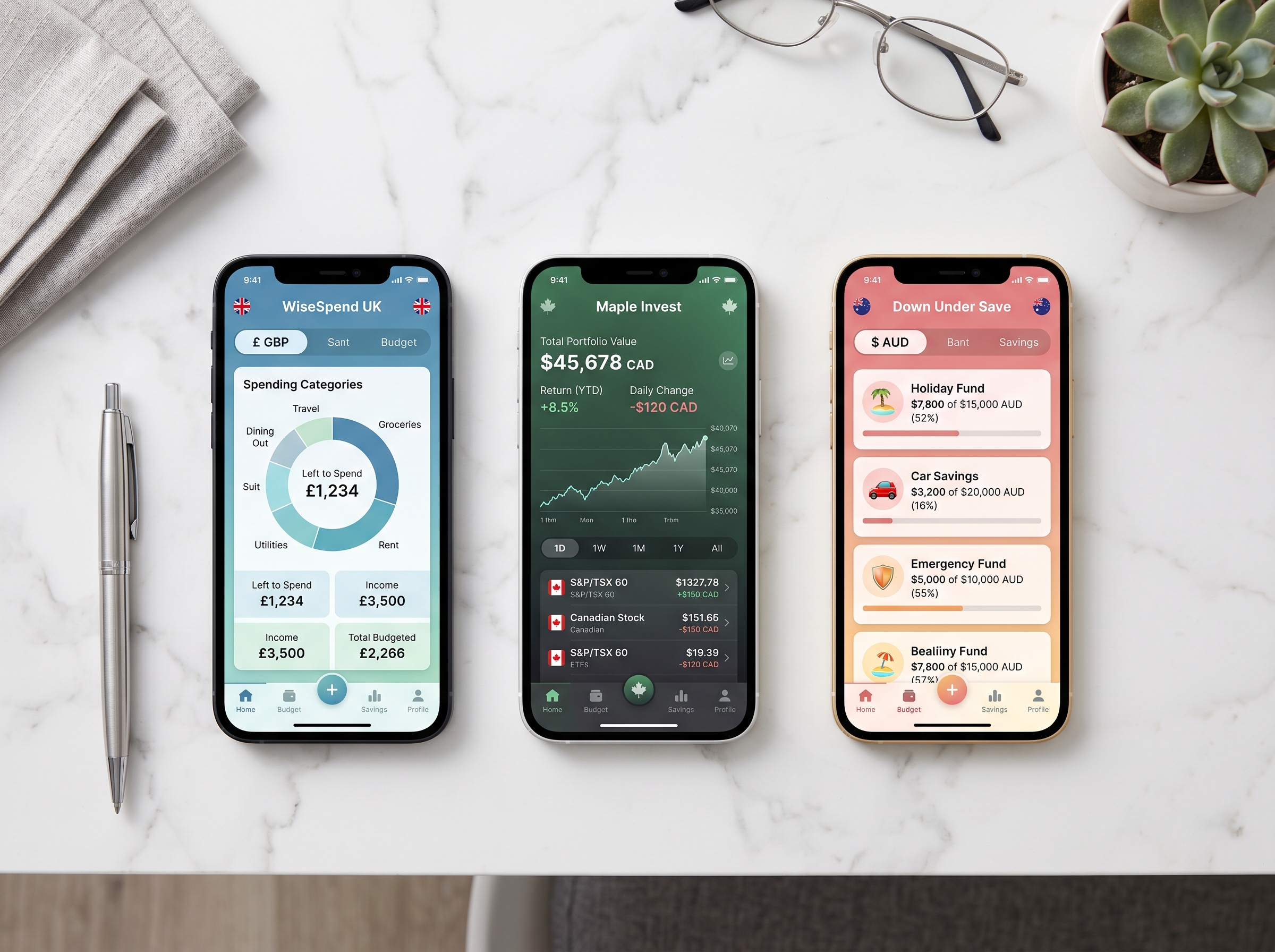
United Kingdom: The UK's open banking framework — mandated under PSD2 — gives AI finance apps unusually powerful access to transaction data across institutions, which has driven a more sophisticated domestic tool market. Plum is the leading AI savings platform in the UK, using machine learning to analyze income patterns and automatically transfer small amounts into savings at optimally timed intervals, without the user having to decide when or how much. Emma is the top choice for subscription management and overdraft prevention — it connects across all UK bank accounts, notifies users about unused subscriptions, and uses predictive logic to alert you before an overdraft occurs. Both are free at their base tier, with premium plans available from £5 to £9.99 per month. UK users investing via a Stocks and Shares ISA should note that many UK investment platforms, including Nutmeg (now owned by JPMorgan) and Moneyfarm, offer robo-advisory services within the ISA tax wrapper, making returns free of capital gains and income tax.
Canada: Wealthsimple is the dominant AI-powered finance platform in Canada, having reached a C$100 billion AUM milestone in 2026. The platform recently launched an AI-powered investment research dashboard that helps users find relevant stocks, analyze portfolio performance, and receive AI-generated market summaries. Its customer-facing AI chatbot now handles 60 to 70% of support queries without human involvement. For RRSP and TFSA account holders, Wealthsimple's automated investing product — charging 0.5% annually for accounts under C$100,000 — is one of the most accessible entry points into registered account investing for Canadians. Wealthsimple also introduced a Retirement Accelerator feature in early 2026, offering low-interest loans to help investors maximize RRSP contributions before the annual deadline.
Australia: Most working Australians already hold baseline life and income protection insurance through their superannuation fund, but the AI tools optimizing how that super performs are improving rapidly. Raiz Invest — listed on the ASX under the ticker RZI — is the leading micro-investing and AI-driven savings platform for Australians, using round-up technology and AI-driven personalization to segment users and tailor financial messaging based on real-time behavioral data. Raiz has integrated generative AI into its marketing and user engagement engine, with AI-enabled digital onboarding improving conversion and retention rates. A$17 to A$30 per month is a typical cost for a standalone investment account for younger Australians. Super fund members seeking more control over their retirement allocation can explore AI-guided self-managed super fund (SMSF) tools, though these carry significantly more administrative responsibility.
Frequently Asked Questions
Q: Are AI personal finance apps safe to connect to my bank account?
Reputable apps in this category — Copilot, Monarch, Betterment, Wealthfront, and others — connect to bank accounts using read-only access via services like Plaid or MX. Read-only access means the app can view your transactions but cannot initiate transfers or payments on your behalf. These connections use bank-level encryption. That said, you are adding another point of data access, so review each app's privacy policy and check whether they sell anonymized data before connecting your accounts.
Q: Can a robo-advisor beat the market?
No — and the best robo-advisors don't try to. Platforms like Wealthfront and Betterment invest primarily in diversified portfolios of low-cost index funds, designed to match market returns rather than beat them. The value comes from consistent rebalancing, tax-loss harvesting (which can add 0.3 to 1.5 percentage points of after-tax return annually, according to Wealthfront's own estimates), and removing behavioral mistakes like panic-selling during downturns. Active stock-picking is not the model.
Q: Is it worth paying $10-$15 a month for an AI budgeting app?
For most users, yes — if they use the app consistently. Research consistently shows that people who actively track their spending spend less. If a $10/month app causes you to cancel one unused subscription, trim one spending category, or avoid one overdraft fee, it has already paid for itself. The key qualifier is consistent use: apps that sit unopened provide no benefit. Choose the one whose interface you will actually open daily or weekly.
Q: Do I need both a budgeting app and a robo-advisor?
They serve fundamentally different purposes. A budgeting app helps you understand and control your current spending. A robo-advisor manages money you have already decided to invest for the long term. Both can be valuable at the same time. A practical sequence: use a budgeting app first to identify surplus cash flow, then direct that surplus to a robo-advisor for automated long-term investing.
Q: What's the biggest risk of using AI for personal finance?
Overreliance and false precision. AI tools surface patterns and projections based on your past behavior and current data — but they cannot predict job loss, unexpected medical expenses, or major life changes. A tool showing you a retirement projection at age 65 is modeling one possible future under assumptions that may not hold. Use AI finance tools as a starting point for decisions, not as the final authority. The Ipsos/TD Bank 2026 survey found that only 18% of users trust AI to make financial recommendations independently — a reasonable degree of caution.
The Bottom Line
AI has moved from the periphery to the center of personal finance in a remarkably short time. The tools available in April 2026 — from Copilot's adaptive categorization to Wealthfront's tax-optimized automated portfolios — are genuinely more useful than anything available two years ago, and the pace of improvement is not slowing. For most people, the most rational starting point is a free or low-cost budgeting app to establish spending visibility, followed by a robo-advisor once you have identified consistent monthly surplus to invest.
The category to be most skeptical of is AI financial advice that sounds like it is replacing a human advisor entirely. The 90% of users who reported profitable outcomes from AI suggestions is encouraging — but the majority of consumers in 2026 still want a human involved in major financial decisions, which is a reasonable instinct. AI tools excel at pattern recognition, automation, and reducing friction. They are less suited to navigating the emotional, circumstantial complexity of a major financial decision: whether to buy a home, when to retire early, how to structure an inheritance.
Use AI where it is strong — daily tracking, automated investing, subscription audits — and direct that freed-up mental energy toward the decisions that genuinely require human judgment. Once your budget is under control and your investments are automated, explore our guides on long-term investing strategies and high-yield savings accounts to put every remaining dollar to work.
Disclaimer: This article is for informational purposes only and does not constitute personalized financial, investment, legal, or tax advice. Always consult a qualified financial professional before making major financial decisions.
Sources
TD Bank / Ipsos. "Nearly 80% of Americans Use AI Tools but Most Still Want Humans Making Financial Decisions." TD Stories, 2026. Link
Ipsos. "Nearly Two in Five Americans Turn to AI for Financial Management Advice." Ipsos, 2026. Link
NVIDIA. "From Pilot to Profit: AI in Financial Services Survey 2026." NVIDIA Blog, 2026. Link
BetaKit. "Wealthsimple Unveils Advanced Investing Tools as It Hits $100-Billion Milestone." BetaKit, 2026. Link
Investment Executive. "Tech Roundup: How Wealthsimple's AI Chatbot Works." Investment Executive, 2026. Link
NerdWallet. "Best Robo-Advisors: Top Picks for April 2026." NerdWallet, April 2026. Link
CostBench. "Copilot Money Pricing 2026." CostBench, 2026. Link
Bankrate. "Best Robo-Advisors In 2026." Bankrate, April 2026. Link
Rask Media. "Raiz Invest Ltd (ASX:RZI) — Scaling Funds Management with Every Dollar." Rask Media, February 2026. Link
Andersen. "Robo-Advisor Statistics 2026." Andersen, 2026. Link