Best Crypto Wallets of April 2026: Hardware vs Software Compared
Crypto hackers stole $3.4B in 2025. Compare the best crypto wallets of April 2026 — hardware and software — to protect your holdings for good.
Key Takeaways
Crypto hackers stole $3.4 billion in 2025 and $482.6 million in Q1 2026 alone — the majority of losses target individual wallets, not exchanges.
Hardware wallets (cold storage) are the gold standard for long-term holdings; software wallets (hot wallets) are best for daily DeFi and swaps.
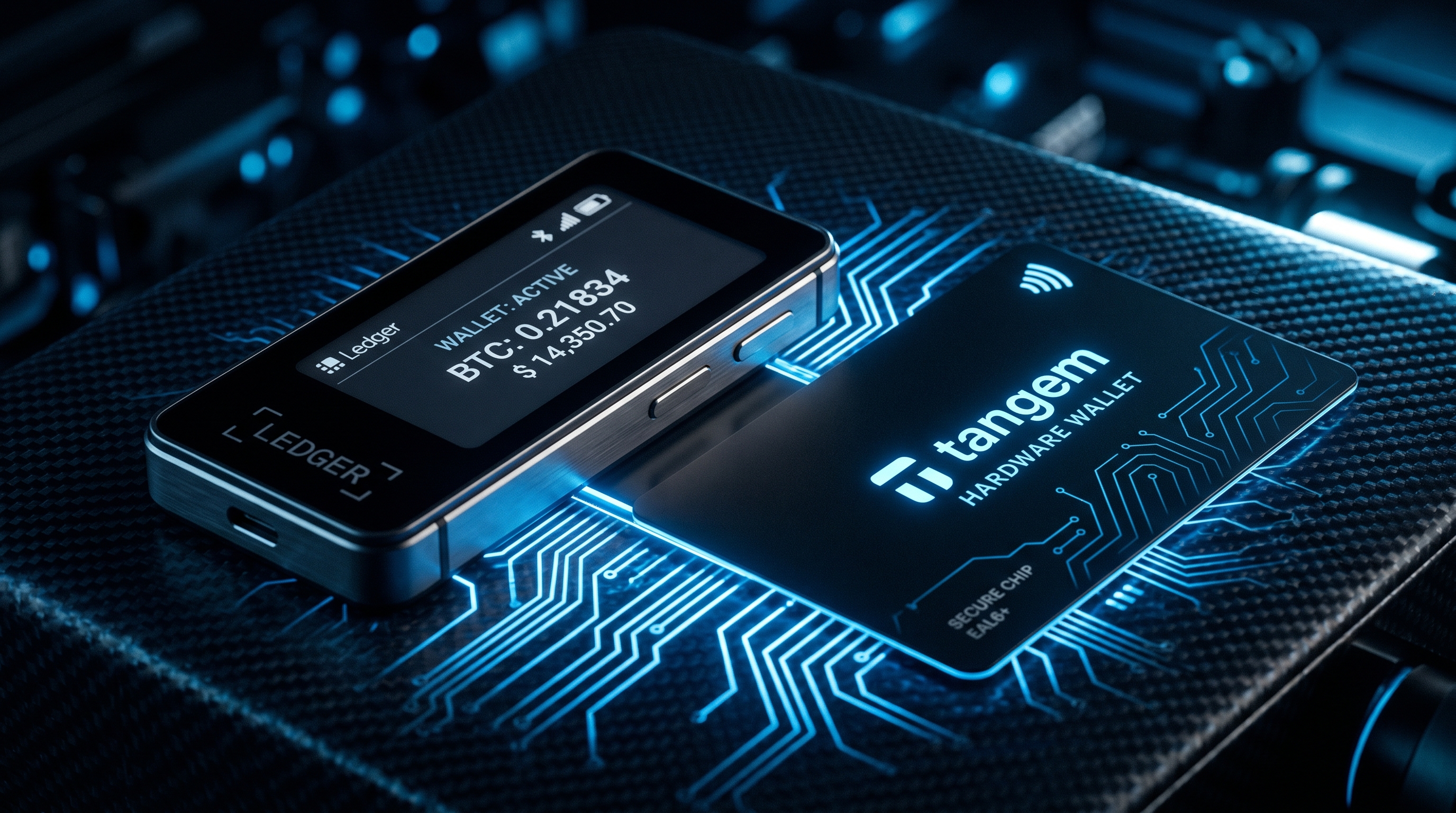
Tangem is the best hardware wallet for most beginners at $50.90 for a two-card set; the Trezor Safe 7 is the top pick for advanced users with its post-quantum cryptography.
MetaMask dominates multi-chain DeFi; Phantom is the best choice for Solana; Exodus wins for beginners who want portfolio tracking and staking in one app.
A hardware wallet for long-term storage paired with a software wallet for active use is the security setup recommended by every major blockchain security firm in 2026.
Crypto hackers stole $3.4 billion across 2025, according to Chainalysis — and the Bybit exchange breach in February alone accounted for $1.5 billion of that total. But exchange hacks represent only half the threat. In 2025, individual wallet compromises hit 158,000 incidents affecting 80,000 unique victims, with $713 million lost to personal wallet attacks. By Q1 2026, phishing and social engineering had already drained $306 million from individual crypto holders — nearly two-thirds of all losses in the first quarter. The message from every blockchain security firm is consistent: not your keys, not your coins. Leaving crypto on an exchange or in a poorly secured software wallet is not storage — it is exposure.
The good news is that self-custody has never been more accessible. Hardware wallets have dropped in price, software wallets have grown dramatically more secure, and the tools available in April 2026 make protecting five figures in crypto just as straightforward as setting up a bank account. The challenge is knowing which wallet to choose for your specific needs — a day trader running Solana DeFi has completely different requirements from someone storing Bitcoin as a long-term hedge.
This guide ranks the best crypto wallets of April 2026 — hardware and software — with honest assessments of fees, security models, supported chains, and who each wallet serves best. We also cover the regulatory context for UK, Canadian, and Australian holders navigating new self-custody reporting rules in 2026.
Hot Wallets vs Cold Wallets: The Fundamental Distinction
Every crypto wallet falls into one of two categories based on how the private key — the cryptographic secret that controls your funds — is stored.
A hot wallet (software wallet) stores the private key on an internet-connected device: your browser, smartphone, or desktop computer. Hot wallets are free, convenient, and essential for interacting with DeFi protocols, NFT marketplaces, and Web3 applications. Their weakness is that any malware, phishing site, or compromised app on the same device can potentially access the key.
A cold wallet (hardware wallet) stores the private key on a dedicated physical device that never connects directly to the internet. When you want to sign a transaction, you plug in the device (or tap it via NFC), confirm on its screen, and the private key never leaves the hardware. An attacker who controls your computer cannot steal keys that are not stored on it.
"Illicit actors have moved up the stack — targeting wallets, keys, and control planes over smart contract code. The $306 million phishing total in Q1 2026 underscores that users remain the weakest link. 95% of individual crypto losses are preventable with proper security practices." — Chainalysis Crypto Crime Report, Q1 2026
The practical framework used by most experienced holders: keep active trading capital in a software wallet for convenience, and store long-term holdings exceeding a few hundred dollars in a hardware wallet where an internet-facing attack cannot reach them. Our guide to the best crypto exchanges of 2026 covers where to buy; this guide focuses on where to store once you own.
Best Hardware Wallets of April 2026
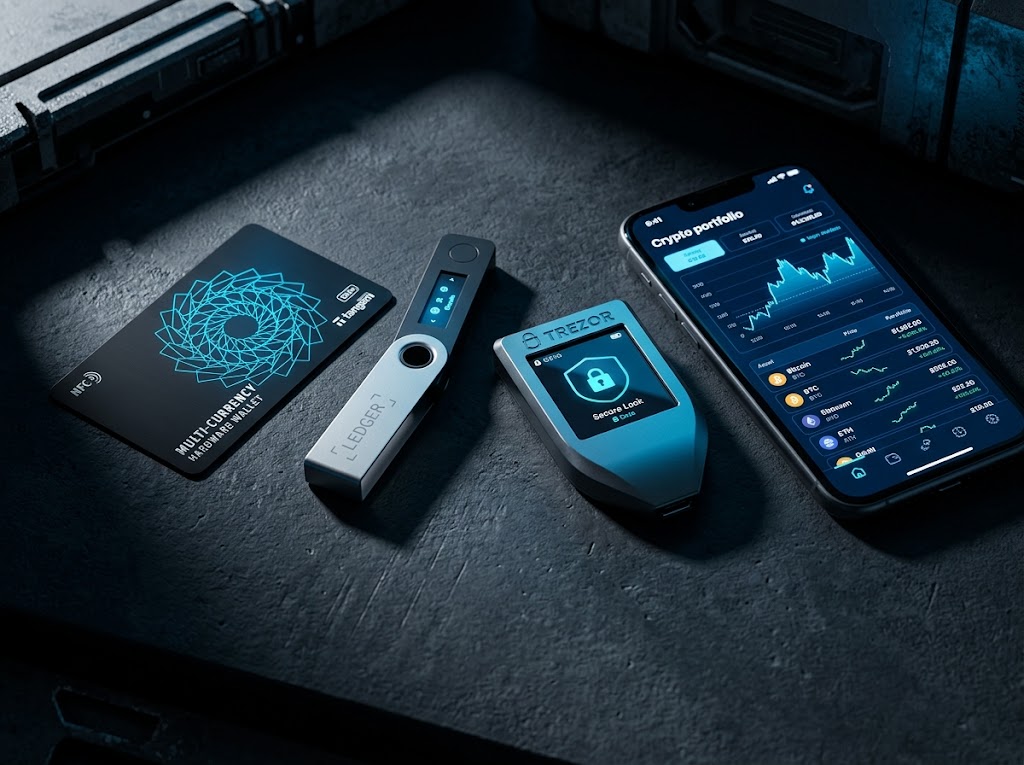
Hardware wallets have evolved significantly. The three models below represent the strongest value propositions at different price points and use cases. All are FIDO2-certified and ship with Secure Element chips that meet EAL5+ or higher certification.
Wallet Price Supported Assets Key Feature Best For Tangem (2-card set) $50.90 16,000+ NFC tap-to-sign, EAL6+, no seed phrase Beginners, travellers Trezor Safe 3 $79 8,000+ 100% open-source, Secure Element Security-conscious users Ledger Nano X $149 5,500+ Bluetooth, Ledger Live ecosystem Mobile-first holders Trezor Safe 7 $249 8,000+ Post-quantum cryptography, Bluetooth, Qi2 wireless charging Advanced users, large holdings Ledger Flex $249 5,500+ E Ink display, NFC, staking via Ledger Live Daily DeFi + long-term storage
Data as of April 2026. Prices and features subject to change. Sources: Coin Bureau, CoinCodex, provider websites.
Tangem — Best Hardware Wallet for Beginners
Tangem operates as a credit-card-sized NFC device — you tap it to your phone to sign transactions, no USB cable or desktop software needed. The setup is the closest the hardware wallet industry has come to the simplicity of a tap-to-pay card. Tangem's most unusual feature is its elimination of the traditional 12- or 24-word seed phrase recovery process. Instead, the device ships as a set of two or three cards: you set a PIN on the primary card and any of the backup cards can restore access. Lose all cards and access is permanently lost — a real limitation — but for most beginners, the simplicity of the NFC-tap model removes the single most common point of failure in hardware wallet security: incorrectly written or stored seed phrases.
The EAL6+ Secure Element chip used by Tangem is the same grade deployed in biometric passports. The 3-card set at $64.90 (roughly $21.64 per card) is the recommended purchase — it includes two backup cards and provides meaningful redundancy for a total cost that is still lower than any competing hardware wallet on the market.
Trezor Safe 7 — Best for Advanced Users
Launched in late 2025, the Trezor Safe 7 is the first mainstream hardware wallet to implement post-quantum cryptography — specifically the SLH-DSA-128 algorithm — for firmware updates, device authentication, and the boot process. This matters because quantum computing poses a credible long-term threat to current elliptic-curve cryptography (ECC), and holders planning to store crypto for a decade or more have genuine reason to prioritize this protection. The Safe 7 also adds Bluetooth connectivity and Qi2 wireless charging, while maintaining Trezor's core advantage: fully open-source firmware that anyone can audit. At $249, it sits at the top of Trezor's lineup and is the right choice for holders with significant long-term positions.
Ledger Nano X — Best for Mobile-First Holders
The Ledger Nano X ($149) pairs via Bluetooth to both iOS and Android, making it the most practical hardware wallet for users who manage crypto primarily from a smartphone. It supports 5,500+ assets and integrates directly with Ledger Live — a robust companion app that handles staking, NFT management, and DeFi access without third-party software. One long-standing criticism of Ledger is that its firmware is closed-source, unlike Trezor's fully open model. Ledger's Secure Element chip and the separation of key storage from internet access remain strong protections, but users who prioritize full transparency in their security stack should consider Trezor instead.
Best Software Wallets of April 2026
Software wallets are free and essential for anyone interacting with DeFi, NFT markets, or Web3 applications. The three wallets below cover the major use cases across Ethereum, Solana, and multi-chain portfolios.
Wallet Supported Chains Swap Fee Key Feature Best For MetaMask EVM chains + BTC + SOL + Cosmos (via Snaps) 0.875% Transaction Shield AI security, Advanced Permissions (ERC-7715) Multi-chain DeFi power users Phantom Solana, Ethereum, Polygon, Bitcoin Variable Human-readable transaction previews, 15M+ monthly users Solana ecosystem users Exodus BTC, ETH, SOL, BNB, AVAX, ARB, BASE, OP, MATIC, TRX 0.5% Built-in portfolio tracker, staking, NFT management Beginners and casual traders Zengo Ethereum, Bitcoin, BNB, Polygon, and 120+ assets Variable Seedless MPC security model — no seed phrase to lose or steal Users prioritizing account recovery security
Data as of April 2026. Fees subject to change. Sources: CryptoSlate, DEXTools, provider documentation.
MetaMask — Best for Multi-Chain DeFi
MetaMask has been the Ethereum standard since 2016 and remains the most widely supported wallet for DeFi protocols, token launches, and Web3 applications. The 2026 version has expanded significantly: the Snaps plugin system now enables native support for Bitcoin, Solana, and Cosmos chains without switching wallets. The standout 2026 feature is Transaction Shield — an AI layer that simulates every transaction before you sign it and alerts you to potential malicious smart contracts, approval drains, or phishing destinations. In April 2026, MetaMask also introduced Advanced Permissions (built on ERC-7715), allowing dApps to request scoped, time-limited execution access rather than requiring a manual signature for every action.
MetaMask charges a transparent 0.875% fee on swaps executed within the wallet — a rate that is clearly disclosed rather than buried in quote spreads. For users who primarily use MetaMask as a DeFi connection tool (rather than for swaps), the fee is irrelevant.
Phantom — Best for Solana
Phantom has grown to over 15 million monthly active users and processes more than $20 billion in annual swap volume, making it the dominant software wallet in the Solana ecosystem. Its core advantage is usability: transaction previews show human-readable summaries of what a smart contract will actually do before you approve it, reducing blind signing risk dramatically. Phantom also auto-filters malicious airdropped tokens from your visible portfolio — a common attack vector where scammers send worthless tokens that trigger drainage scripts if you attempt to sell them. In August 2025, Phantom acquired Solsniper, a trading and analytics platform, indicating ongoing investment in advanced trading features within the app. Phantom also supports Ethereum, Polygon, and Bitcoin, making it increasingly viable as a multi-chain wallet for users whose primary chain is Solana.
Exodus — Best for Beginners
Exodus is the most beginner-friendly software wallet on the market — it combines portfolio tracking, swaps, staking, and NFT management in a single clean interface without requiring any technical knowledge. It supports ten major blockchains including Bitcoin, Ethereum, Solana, BNB Smart Chain, and Avalanche. Exodus cut its swap fee to 0.5% in early 2025, making it competitive for occasional in-wallet trades. Its principal limitation is that it does not support the full breadth of DeFi protocols that MetaMask does — for straightforward holding, staking, and occasional swaps, Exodus is hard to beat, but active DeFi users will need MetaMask alongside it.
Crypto Wallet Rules for UK, Canadian, and Australian Holders
Self-custody — holding crypto in your own wallet rather than on an exchange — is legal in all Tier 1 markets. However, 2026 has brought new regulatory reporting requirements that affect how platforms handle your data, and tax treatment varies by country.
United Kingdom: From 1 January 2026, the UK has implemented the OECD's Crypto-Asset Reporting Framework (CARF), giving HMRC direct access to transaction data from regulated crypto exchanges operating in the UK. Simply transferring crypto from an exchange to your own hardware wallet does not trigger a taxable event — HMRC taxes disposals (sales, swaps, spending). However, that withdrawal now links your exchange identity to your wallet address. For UK holders, the practical implication is straightforward: maintain accurate records of cost basis for every acquisition, because HMRC's enforcement capability has significantly improved in 2026.
Canada: The Canada Revenue Agency (CRA) treats crypto as a commodity. Transferring between wallets you own is not a taxable event. Selling, swapping, or using crypto to purchase goods is a taxable capital gain or business income event depending on your trading frequency. Canadians using a TFSA cannot shelter crypto gains inside the account — the CRA does not permit direct crypto holdings in registered accounts; only crypto ETFs held through a licensed investment platform qualify.
Australia: In April 2026, Australia passed its first comprehensive digital-asset law requiring crypto exchanges and custody providers to obtain Australian Financial Services Licenses (AFSL) from ASIC. For self-custody holders, the change is minimal: the ATO confirmed that transferring crypto between wallets you own remains a non-taxable event. The 50% Capital Gains Tax discount for assets held longer than 12 months still applies to crypto. Effective 31 March 2026, the Travel Rule now requires exchanges to attach identity information to transfers involving self-hosted wallets, which means withdrawals to your hardware wallet from an Australian exchange will require verification of the wallet address.
Frequently Asked Questions
Q: What happens if I lose my hardware wallet?
Your funds are not lost as long as you have your seed phrase (the 12 or 24 words generated during setup). You simply purchase a new device and restore the wallet using the seed phrase — your funds reappear in full. The exception is Tangem, which uses a backup-card system instead of a seed phrase. With Tangem, if you lose all of your cards (primary and backups), access is permanently lost. For all other hardware wallets, the seed phrase is the master key — store it on paper or metal in a secure, offline location. Never store it digitally or in a screenshot.
Q: Can I use a hardware wallet with a software wallet at the same time?
Yes — and this is the recommended setup. The most common configuration is using a Ledger or Trezor as the key holder while connecting it to MetaMask as the interface. When you interact with a DeFi app through MetaMask, the transaction is sent to your hardware device for signing. The private key never leaves the hardware, but you still get MetaMask's full ecosystem access. This combination provides the usability of a hot wallet with the security of cold storage.
Q: Is it safe to store all my crypto in a software wallet?
For small amounts used in active trading, yes — software wallets from MetaMask, Phantom, and Exodus are reasonably secure if your device is clean and you practice good security hygiene (unique passwords, two-factor authentication on email and exchange accounts, and vigilance against phishing). For any amount you would not want to lose — generally $500 or more — a hardware wallet is strongly recommended. The $306 million stolen via phishing in Q1 2026 alone confirms that software-only storage carries meaningful risk for material holdings.
Q: Do I pay taxes when I move crypto to my own wallet?
No — in the US, UK, Canada, and Australia, transferring crypto between wallets you own is not a taxable event. Tax is triggered by disposals: selling crypto for fiat currency, swapping one crypto for another, or using crypto to pay for goods and services. Keeping accurate records of when you acquired each asset and at what price (your cost basis) is essential for calculating gains accurately when you do dispose.
Q: What is the safest crypto wallet overall?
For maximum security, the Trezor Safe 7 ($249) is the strongest option available in April 2026 — fully open-source firmware, a Secure Element chip, and the first mainstream implementation of post-quantum cryptography. For most people balancing security and convenience, a Tangem 3-card set ($64.90) with its EAL6+ chip and NFC simplicity offers excellent protection at a fraction of the cost. The "safest" wallet is ultimately the one you actually use correctly — a $400 hardware device left in a drawer while you store everything on an exchange is less safe than a $65 Tangem you use daily.
The Bottom Line
The crypto theft numbers from 2025 and early 2026 are not anomalies — they reflect a maturing, high-value ecosystem that attracts sophisticated attackers. The only meaningful protection is self-custody, and the hardware wallet market in April 2026 makes that protection more accessible than ever. For most holders, the right setup is clear: a Tangem 3-card set for offline storage of long-term positions, paired with MetaMask or Phantom for any active DeFi or trading activity. Total cost: under $150.
Once your custody setup is secure, the next question is what to hold in it. Our guides to the best crypto exchanges of 2026 and how to build a long-term investment portfolio cover the rest of the picture. Security is the foundation — start there.
Disclaimer: This article is for informational purposes only and does not constitute personalized financial, investment, legal, or tax advice. Cryptocurrency is highly volatile and carries significant risk of loss. Always consult a qualified financial or tax professional before making decisions about crypto holdings or self-custody arrangements.
Sources
Chainalysis. "2025 Crypto Theft Reaches $3.4 Billion." January 2026. Link
TechNext24. "Crypto hackers steal $482.6 million in 44 attacks in Q1 2026." April 2026. Link
Coin Bureau. "Best Crypto Hardware Wallets of 2026: Compare The Top 11." April 2026. Link
CoinCodex. "17 Best Crypto Hardware Wallets in April 2026." April 2026. Link
CryptoSlate. "Exodus Wallet Review 2026 — Security, Fees, Supported Chains." 2026. Link
CryptoSlate. "Phantom Wallet Review 2026: Security, Fees and Features." 2026. Link
DEXTools. "Phantom vs MetaMask: Which Crypto Wallet Should You Use in 2026?" 2026. Link
TaxBit. "New Crypto Tax Rules Effective 2026: What UK Firms Must Do to Comply With HMRC and CARF." 2026. Link
CoinDesk. "Australia passes crypto regulation requiring exchanges to obtain financial services licenses." April 2026. Link
KuCoin. "Hardware Wallet Comparison 2026: Ledger vs. Trezor — New Models, New Risks." 2026. Link