Best CD Rates of April 2026: Lock In Up to 4.50% APY
The best CD rates hit 4.50% APY in April 2026 — but Fed rate cuts are coming. Lock in a guaranteed return now before yields fall to 3.50% by year-end.
Key Takeaways
The best CD rates in April 2026 reach 4.50% APY — more than nine times the national average savings account rate of 0.46% APY.
The Federal Reserve has held its benchmark rate at 4.25%–4.50% since December 2024, but 2–3 cuts are projected by year-end, making now a strong window to lock in high rates.
Short-term CDs (5–12 months) currently offer the highest yields; a laddering strategy lets you capture today's rates while staying flexible.
All CDs at FDIC-insured banks (US) or NCUA-insured credit unions are protected up to $250,000 per depositor — making them among the safest savings vehicles available.
UK savers can access equivalent fixed-rate bonds up to 4.60% AER; Canadian GICs offer up to 3.80% on 1-year terms; Australian term deposits reach 4.75% for 12-month terms.
The window to lock in a genuinely high, guaranteed return on your cash may be closing. As of April 2026, the best certificate of deposit (CD) rates sit at 4.50% APY — but the Federal Reserve has signaled two to three interest rate cuts before the end of the year. Once those cuts arrive, CD rates will fall quickly, and the opportunity to earn 4%+ on risk-free, FDIC-insured savings will be gone. According to Bankrate senior analyst Ted Rossman, the top 1-year CD rate is projected to drop to approximately 3.50% APY by December 2026.
Right now, the average traditional bank savings account still pays just 0.46% APY, according to FDIC data from March 2026. Parking $50,000 in a CD at 4.50% APY instead of a standard savings account earns an additional $2,020 in interest over 12 months — for zero extra effort and zero additional risk. That is not a small difference.
This guide covers the best CD rates available in April 2026, explains how to choose the right term for your situation, walks through CD laddering strategies, and covers equivalent products for savers in the UK, Canada, and Australia.
What Is a Certificate of Deposit and How Does It Work?
A certificate of deposit (CD) is a time-bound savings account offered by banks and credit unions. You deposit a fixed sum for a set period — typically anywhere from one month to five years — and the institution pays you a fixed interest rate in return. At maturity, you receive your principal back plus all accumulated interest.
The defining feature of a CD is the rate lock. Unlike a high-yield savings account (HYSA), where the rate can be changed by the bank at any time, the rate on a CD is guaranteed for the life of the term. If you open a 12-month CD at 4.25% APY today and the Fed cuts rates three times over the next year, you still collect 4.25% — no change, no surprises.
The trade-off is liquidity. Withdrawing funds before the CD matures typically triggers an early withdrawal penalty, which is usually three to six months of interest on short-term CDs and six to twelve months of interest on longer terms. For money you know you will not need for the duration, this is no concern. For an emergency fund, a high-yield savings account remains the more appropriate choice — and our guide to high-yield savings accounts covers those options in detail.
Best CD Rates in April 2026
Online banks and credit unions consistently outpace traditional brick-and-mortar institutions on CD rates. The banks below were screened for FDIC insurance, publicly available rate disclosures, and no hidden maintenance fees.
Bank / Institution APY Term Minimum Deposit Best For United Fidelity Bank 4.50% 12 months $1,000 Highest 1-year rate OMB Bank 4.25% 5 months $1,000 Short-term flexibility E*TRADE Bank 4.10% 12 months $1,000 Brokerage account holders Marcus by Goldman Sachs 4.00% 12 months $500 Low minimum deposit Sallie Mae Bank 4.00% 60 months $2,500 Best 5-year rate E*TRADE Bank 3.95% 60 months $1,000 5-year runner-up Marcus by Goldman Sachs 3.90% 60 months $500 5-year + low minimum Bread Savings 3.85% 60 months $1,500 5-year with trusted brand
Data as of April 2026. Rates subject to change. Verify current rates directly with each institution before opening an account. Sources: Bankrate, NerdWallet, provider websites.
"The best 1-year CD rate will likely be closer to 3.50% APY by the end of 2026 as the Fed cuts rates. Savers who lock in now at 4.25%–4.50% are making a smart move." — Ted Rossman, Senior Industry Analyst, Bankrate, 2026
How to Build a CD Ladder in 2026
A CD ladder is one of the most effective strategies for maximizing yield while preserving access to your funds on a rolling basis. Instead of depositing all your savings into a single CD, you divide the money across multiple CDs with staggered maturity dates. As each rung matures, you reinvest at whatever rate is then available — or withdraw if you need the cash.
Here is how to build a straightforward five-rung ladder with $25,000 in April 2026:
Open a 12-month CD ($5,000 at 4.50% APY) — This matures in April 2027. You earn approximately $225 in interest.
Open a 2-year CD ($5,000 at ~4.00% APY) — Matures April 2028. Provides a buffer if short-term rates fall sharply before your first rung renews.
Open a 3-year CD ($5,000 at ~3.75% APY) — Matures April 2029. Mid-range rates with a medium-term lock.
Open a 4-year CD ($5,000 at ~3.80% APY) — Matures April 2030. Earning above today's 5-year rates with one year less commitment.
Open a 5-year CD ($5,000 at 4.00% APY) — Matures April 2031. Locks in today's relatively high long-term rate through a full rate cycle.
Once the first rung matures in April 2027, you reinvest that $5,225 into a new 5-year CD — whatever rate that is at the time. Over a full cycle, the ladder smooths out rate fluctuations and ensures you never have more than 20% of your savings locked up at once.
Expert Insight: "A CD ladder is one of the most elegant tools in personal finance — it's not sexy, but it's almost impossible to lose money. For cash you won't need for at least a year, it's hard to beat locking in a guaranteed 4%+ return while the window remains open." — Greg McBride, CFA, Chief Financial Analyst, Bankrate, 2026
Pro Tip: Check whether your bank offers a no-penalty CD before committing to a traditional CD. Marcus by Goldman Sachs currently offers an 11-month no-penalty CD at approximately 3.90% APY, which lets you withdraw the full balance without fees after the first seven days. The rate is slightly lower than the best standard CDs, but the flexibility is worth it if your plans are uncertain.
CD vs. High-Yield Savings Account: Which Is Right for You?
Both products are FDIC-insured (or NCUA-insured at credit unions) and both offer dramatically better returns than traditional savings accounts. The choice comes down to whether you value a locked-in rate or ongoing flexibility.
Choose a CD if:
You will not need the money for the CD's full term — This is the single most important criterion. Early withdrawal penalties can erode several months of interest.
You want rate certainty — With the Fed cutting rates in 2026, a CD locks in today's higher rate regardless of what happens to the broader rate environment.
You have a specific savings goal with a known timeline — A house down payment in 18 months, a tuition payment in 12 months, or a planned large purchase all map well to CD terms.
Choose a high-yield savings account if:
The funds are your emergency fund — An emergency fund must be accessible immediately. A CD is the wrong vehicle for money you might need tomorrow.
You want to continue making deposits — CDs typically do not allow additional contributions after opening. A HYSA lets you add to the account as your savings grow.
You expect rates to rise — A HYSA rate adjusts upward if the Fed hikes. A CD keeps you locked into today's rate even if better rates appear later.
CDs in the UK, Canada, and Australia
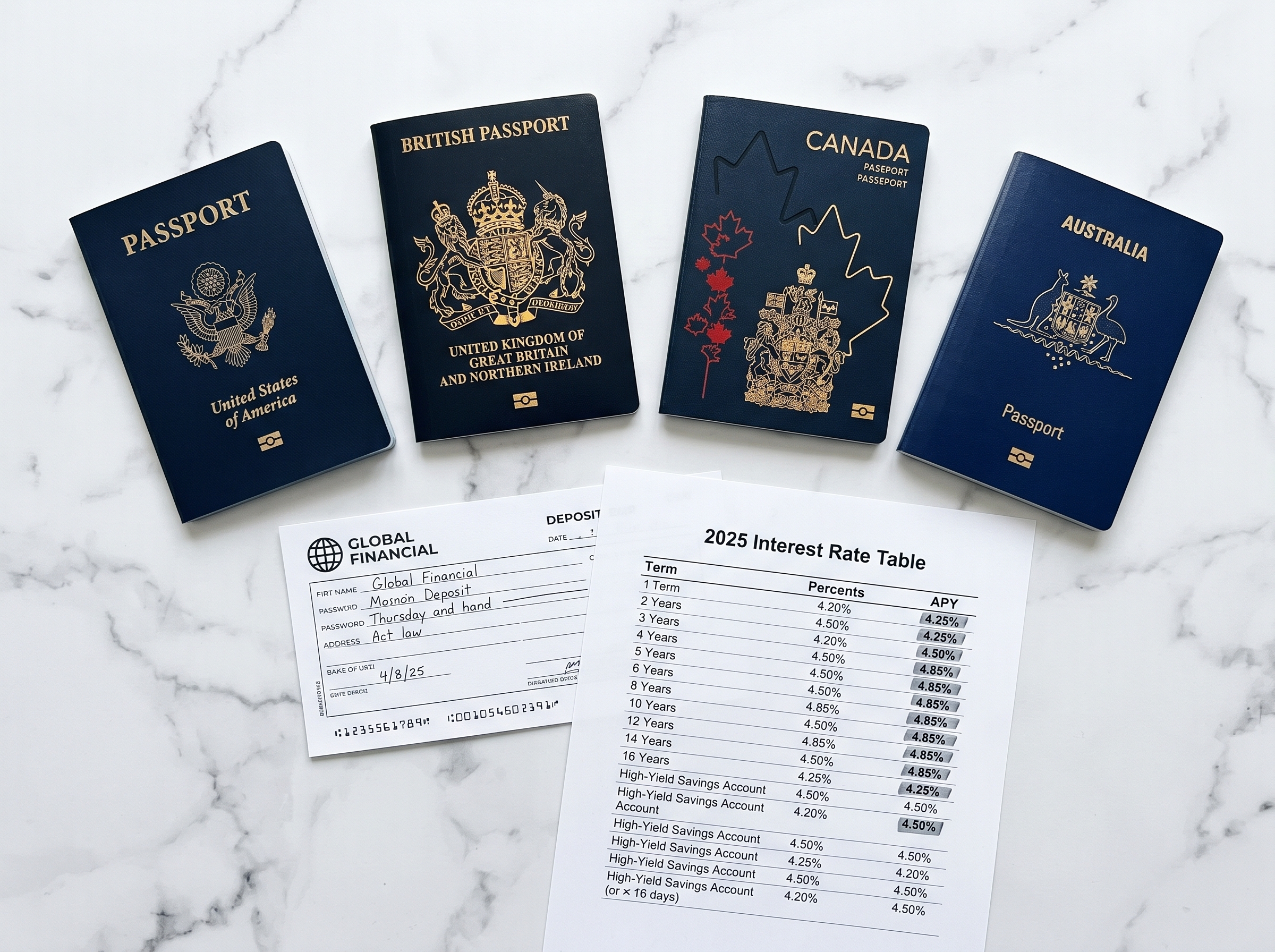
The CD concept exists in all four Tier 1 markets, though it goes by different names and carries different tax treatment in each jurisdiction.
United Kingdom: The equivalent product is called a fixed-rate bond or fixed-rate cash ISA. As of April 2026, Al Rayan Bank and Atom Bank offer fixed-rate bonds up to 4.60% AER on 1-year terms. Interest earned outside an ISA wrapper is subject to income tax above the Personal Savings Allowance (£500 for higher-rate taxpayers, £1,000 for basic-rate taxpayers). Savers should strongly consider using their £20,000 annual Cash ISA allowance before opening a taxable fixed-rate bond.
Canada: The Canadian equivalent is a Guaranteed Investment Certificate (GIC), offered by banks and credit unions. As of April 2026, EQ Bank offers 1-year GICs at approximately 3.80% and Oaken Financial offers comparable rates. GIC interest is taxed as ordinary income in non-registered accounts. Canadian savers should consider holding GICs inside a Tax-Free Savings Account (TFSA) or an RRSP to shelter the interest from CRA taxation.
Australia: The product is simply called a term deposit. As of April 2026, ING Australia and Judo Bank are among the leaders, offering 12-month term deposit rates up to 4.75% per annum. Interest is included in assessable income and taxed at the individual's marginal tax rate. Australian savers using an SMSF (Self-Managed Super Fund) may hold term deposits at a concessional tax rate of 15%.
Frequently Asked Questions
Q: Are CDs safe if the bank fails?
Yes. CDs held at FDIC-insured banks are protected up to $250,000 per depositor, per institution, per ownership category. Credit union CDs have equivalent protection through the NCUA. In the US, no depositor has ever lost a single dollar of FDIC-insured funds. UK fixed-rate bonds benefit from FSCS protection up to £85,000; Canadian GICs are covered by CDIC up to C$100,000 per depositor category; Australian term deposits are protected by the Australian Government Financial Claims Scheme (FCS) up to A$250,000.
Q: What happens to my CD if interest rates go up after I open it?
Nothing — you keep earning the rate you locked in. Your CD rate does not change after you open it, regardless of what happens to market interest rates. This is both the key benefit (rate certainty when rates fall) and a potential downside (you miss out if rates rise further). If you believe rates may increase, a shorter-term CD or a no-penalty CD preserves flexibility to reinvest at higher rates later.
Q: Can I open a CD with just $500?
Yes. Marcus by Goldman Sachs requires just $500 to open a CD, and currently offers 4.00% APY on 12-month terms. Synchrony Bank, Ally Bank, and Bread Savings also have low or no minimum deposit requirements on many of their CD products. Always confirm the current minimum before applying, as minimums can change.
Q: Should I choose a 6-month CD or a 12-month CD right now?
In April 2026, 12-month CDs are offering slightly higher rates than 6-month CDs at most banks. If you can commit the funds for a full year, the 12-month term provides both better yield and greater rate certainty heading into a period of expected rate cuts. If there is any possibility you will need the money within six months, the shorter term or a no-penalty CD is the safer choice.
Q: Is CD interest taxable?
In the United States, yes — CD interest is taxed as ordinary income at the federal level and in most states. Your bank will issue a 1099-INT form reporting the interest earned each calendar year, even if the CD has not yet matured. Some savers hold CDs inside a traditional IRA or Roth IRA to defer or eliminate the tax. Consult a tax professional about the most tax-efficient structure for your situation.
The Bottom Line
April 2026 represents an exceptional — and potentially closing — opportunity to lock in guaranteed, risk-free returns near 4.50% APY on your cash. The Federal Reserve is widely expected to cut rates two to three times before the end of 2026, and when it does, CD rates will follow within weeks. Savers who act now can protect a portion of their cash from those incoming cuts for the next one to five years, depending on their chosen term.
The strategy most appropriate for the majority of savers is a simple CD ladder: spread your savings across 12-month, 2-year, and 5-year CDs to capture today's high short-term rates while keeping a portion locked in at today's long-term rates as insurance against a deeper rate-cutting cycle. Keep your emergency fund — typically three to six months of expenses — in a high-yield savings account where it remains fully liquid.
If you are building toward a larger financial goal — whether that is a down payment, a tuition bill, or a retirement income bridge — a CD offers something almost nothing else can: a written, unconditional guarantee of what your money will return. Explore your options at Bankrate or NerdWallet to compare current rates and find the institution that fits your minimum deposit and term needs. Also consider how your investment portfolio and CD allocation fit together as part of your overall financial plan.
Disclaimer: This article is for informational purposes only and does not constitute personalized financial, investment, legal, or tax advice. CD rates change frequently. Always verify current rates directly with institutions before opening an account. Consult a qualified financial professional before making major financial decisions.
Sources
Rossman, Ted. "Best CD Rates April 2026." Bankrate, April 2026. Link
McBride, Greg. "CD Laddering Strategy Guide." Bankrate, March 2026. Link
Federal Deposit Insurance Corporation. "National Rates and Rate Caps — March 2026." FDIC, March 2026. Link
Federal Reserve. "Federal Open Market Committee Statement, March 2026." Board of Governors of the Federal Reserve System, March 2026. Link
NerdWallet Research. "Best CD Rates of April 2026." NerdWallet, April 2026. Link
Association of British Insurers / FSCS. "Fixed-Rate Bond and Cash ISA Rates — April 2026." Financial Services Compensation Scheme, April 2026. Link
Canada Deposit Insurance Corporation. "CDIC Protection — April 2026." CDIC, April 2026. Link
Australian Prudential Regulation Authority. "Financial Claims Scheme — Term Deposits." APRA, April 2026. Link