Best Bitcoin ETFs of April 2026: BlackRock, Fidelity, and Beyond
US spot Bitcoin ETFs hit $96.5B in AUM and $18.7B in Q1 2026 inflows. Here are the best Bitcoin ETFs of April 2026 — ranked by fee, size, and issuer.

Key Takeaways
US spot Bitcoin ETFs collectively hold approximately $96.5 billion in assets under management as of mid-April 2026 — and they attracted $18.7 billion in net inflows during Q1 2026 alone.
BlackRock's iShares Bitcoin Trust (IBIT) dominates with roughly $54 billion in AUM and captured 45% of all Q1 2026 inflows; it charges 0.25% per year.
Morgan Stanley became the first major US bank to launch its own spot Bitcoin ETF (MSBT) on April 8, 2026 — at 0.14%, it carries the lowest expense ratio of any Bitcoin ETF currently available.
Spot Bitcoin ETFs now hold approximately 1.5 million BTC, representing 7.1% of Bitcoin's entire 21-million-coin maximum supply.
ETFs and direct Bitcoin are taxed identically on capital gains in the US, UK, Canada, and Australia — but ETFs simplify reporting significantly with broker-issued tax forms.
Two years after the SEC approved the first spot Bitcoin ETFs in January 2024, the product has become one of the fastest-growing fund categories in Wall Street history. US spot Bitcoin ETFs collectively reached $96.5 billion in assets under management by mid-April 2026 — a figure that took gold ETFs more than a decade to achieve. For investors who want exposure to Bitcoin's price movements without managing wallets, private keys, or exchange accounts, these funds have made the entry barrier essentially zero: buy shares through any brokerage account, exactly as you would a stock.
The market is maturing fast. Morgan Stanley launched the first spot Bitcoin ETF issued directly by a major US bank (MSBT) on April 8, 2026, charging just 0.14% — the lowest expense ratio in the category. Goldman Sachs filed for its own Bitcoin ETF the same week, triggering $411.5 million in single-day inflows across the sector. The SEC also approved options trading on spot Bitcoin ETFs in late March 2026, opening the door to new hedging and income strategies. Meanwhile, Grayscale's legacy GBTC product — which still charges 1.50% per year — continues to bleed assets to lower-cost competitors as investors migrate to the new generation of funds.
In this guide, we rank the best Bitcoin ETFs of April 2026 by expense ratio, AUM, liquidity, and issuer reputation, explain the ETF-versus-direct-ownership trade-off, and break down the tax treatment across the US, UK, Canada, and Australia.
What Is a Spot Bitcoin ETF and How Does It Work in 2026?
A spot Bitcoin ETF is a fund that holds actual Bitcoin in custody and issues shares that trade on a regulated stock exchange. When you buy one share of BlackRock's IBIT, you are buying a proportional claim on real Bitcoin held by Coinbase Custody on BlackRock's behalf. The ETF's share price tracks Bitcoin's spot price throughout the trading day, minus the small annual management fee deducted from the fund's assets.
This is meaningfully different from the futures-based Bitcoin ETFs that existed before January 2024, such as ProShares BITO. Futures ETFs do not hold Bitcoin directly — they hold Chicago Mercantile Exchange futures contracts that must be continuously rolled forward as they expire, creating a structural "roll cost" that can cause the fund to underperform Bitcoin's actual price over time. Spot ETFs eliminate this drag entirely. Every dollar of investor capital buys actual BTC, and the fund's performance mirrors the spot price closely, minus the management fee.
The practical implications are significant. A spot Bitcoin ETF can be held inside a traditional brokerage account, an IRA, a 401(k), or a UK ISA — in jurisdictions where the products are available. There are no seed phrases, no wallet backups, no exchange accounts, and no risk of self-custody errors. The trade-off is the ongoing expense ratio and the fact that ETF investors cannot spend, transfer, or stake their Bitcoin holdings.
"Spot Bitcoin ETFs attracted $18.7 billion in net inflows during Q1 2026, with BlackRock's IBIT alone capturing approximately 45% of all new capital entering the category." — Blocklr, Bitcoin ETF Performance Q1 2026 Report
Best Bitcoin ETFs of April 2026: Full Comparison Table
The table below ranks the leading spot Bitcoin ETFs available to US investors as of April 2026, ordered by expense ratio. All figures have been sourced from fund issuers and ETF data providers.
ETF (Ticker) Issuer Expense Ratio AUM (April 2026) Best For MSBT Morgan Stanley 0.14% New (Apr 2026) Lowest cost; major bank issuer BTC (Mini) Grayscale 0.15% ~$3.0B Lowest cost among established funds BITB Bitwise 0.20% ~$4.5B+ Crypto-native issuer, strong Q1 inflows HODL VanEck 0.20% ~$1.4B Fee waiver on first $2.5B AUM ARKB ARK 21Shares 0.21% ~$3.6B Cathie Wood's bullish Bitcoin thesis IBIT BlackRock 0.25% ~$54B Largest, most liquid, most trusted FBTC Fidelity 0.25% ~$17.7B Self-custody via Fidelity Digital Assets GBTC Grayscale 1.50% ~$14.9B Legacy fund — avoid unless legacy holder
Data as of April 2026. AUM figures are approximate and change daily with Bitcoin price movements and fund flows. Expense ratios shown are standard annual fees — some waivers apply for limited periods. Always verify current terms at the fund issuer's website before investing. Sources: Motley Fool, ETF.com, Blocklr, CoinGlass.
BlackRock IBIT — Best Overall
IBIT is the undisputed market leader. With approximately $54 billion in assets under management, it is the most liquid Bitcoin ETF by a wide margin — a critical advantage for institutional investors and anyone making large trades who needs to minimise bid-ask spread. In Q1 2026, IBIT attracted $8.4 billion in net inflows, or roughly 45% of all capital entering the spot Bitcoin ETF category. Coinbase Custody holds the underlying Bitcoin. The 0.25% expense ratio is mid-range among spot ETFs, but the fund's size, liquidity, and BlackRock's institutional credibility make it the default choice for most long-term investors.
Fidelity FBTC — Best for Self-Custody Advocates
FBTC distinguishes itself from every other major Bitcoin ETF through one important structural difference: Fidelity Digital Assets holds the underlying Bitcoin in-house, rather than outsourcing custody to Coinbase. For investors concerned about third-party custodian risk, this is a meaningful distinction. With $17.7 billion in AUM and the same 0.25% expense ratio as IBIT, FBTC is a credible alternative for Fidelity account holders who want to keep their entire portfolio within one platform.
Morgan Stanley MSBT — Best Lowest Cost
Launched on April 8, 2026, MSBT makes Morgan Stanley the first major US bank to issue a spot Bitcoin ETF directly under its own name. At 0.14%, it carries the lowest annual fee in the category — meaning a $100,000 investment costs just $140 per year versus $250 at IBIT. It is new and therefore carries early-stage liquidity risk that more established funds do not, but for fee-conscious investors comfortable with Morgan Stanley as a counterparty, MSBT is worth watching closely as it scales.
Grayscale GBTC — Avoid for New Money
GBTC was the dominant Bitcoin investment vehicle before spot ETFs existed, and it still holds $14.9 billion in assets — but its 1.50% annual fee is roughly six to ten times higher than competing products. On a $50,000 investment held for five years, GBTC's fee structure costs approximately $3,750 more than IBIT would over the same period (assuming flat prices). Existing holders who bought GBTC at a discount years ago may have complex tax reasons to stay, but new investors have no rational basis for choosing GBTC over its cheaper peers.
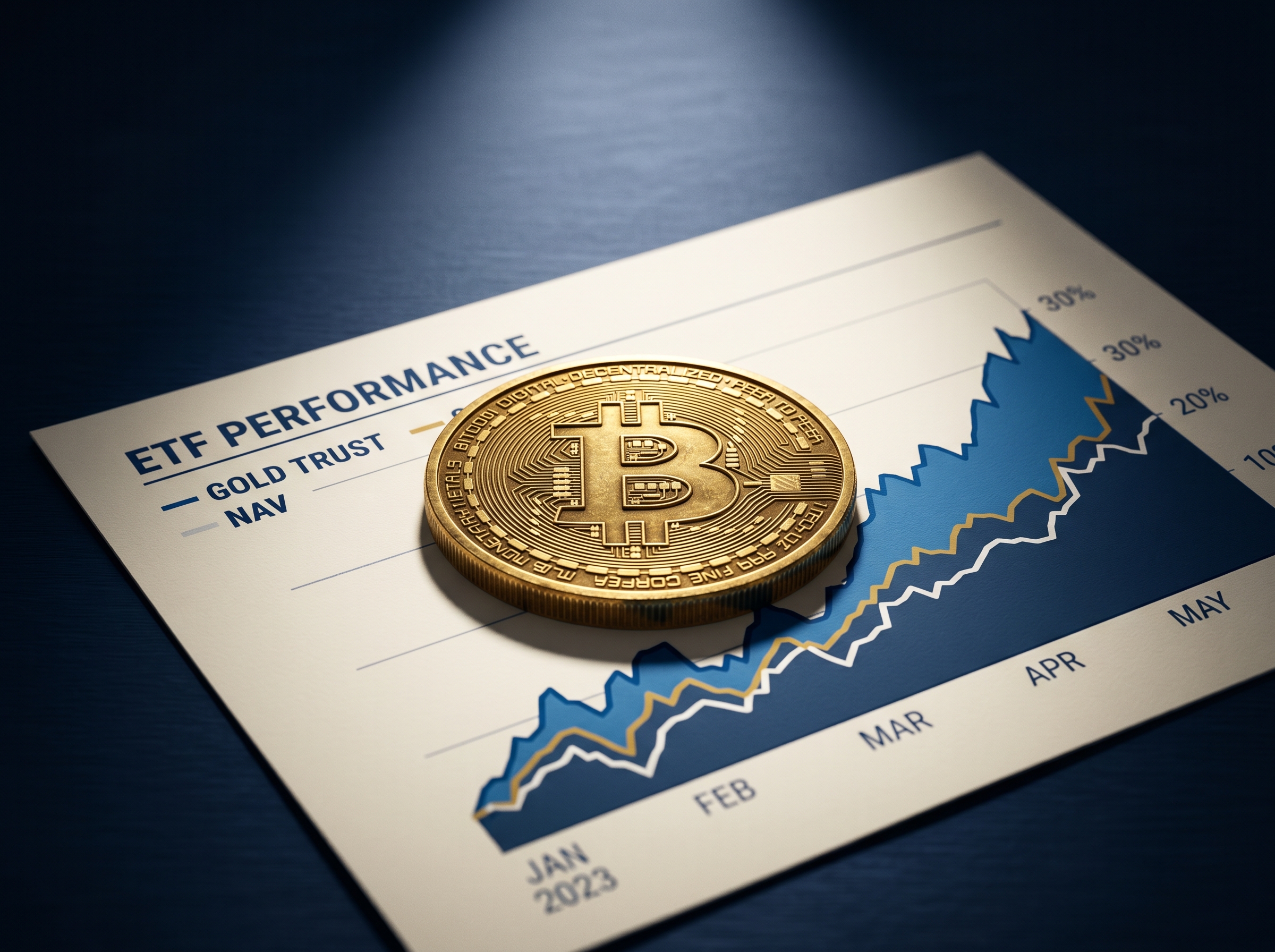
Bitcoin ETF vs. Buying Bitcoin Directly: How to Choose
Spot Bitcoin ETFs and direct Bitcoin ownership are not interchangeable — each has genuine advantages depending on your financial situation, goals, and technical comfort. Here is a clear framework for deciding which approach is right for you.
Choose a Bitcoin ETF if: You invest through a brokerage account, IRA, 401(k), or UK Stocks and Shares ISA and want Bitcoin exposure without opening a separate crypto exchange account. ETFs are the simplest path for traditional investors, financial advisors managing client portfolios, and retirement account holders. Reporting at tax time is straightforward — your broker provides a 1099-B (US) or equivalent.
Choose direct Bitcoin if: You want to hold Bitcoin for more than five years and prefer to avoid paying an annual management fee indefinitely. Buying BTC on an exchange and moving it to a hardware wallet costs nothing annually after the initial purchase. Over a ten-year holding period, even a 0.20% expense ratio on a large position compounds into a meaningful cost. Direct ownership also allows you to spend, send, or stake your Bitcoin — options unavailable to ETF holders.
Consider both: Many investors use a hybrid approach — a Bitcoin ETF inside a tax-advantaged account (Roth IRA, SIPP, TFSA) for the tax efficiency, and a hardware wallet for the portion they want to self-custody long-term. This captures the best of both worlds without concentration in either structure.
Never choose futures ETFs: Futures-based Bitcoin ETFs (such as ProShares BITO) suffer from structural roll costs that cause them to underperform Bitcoin's spot price over time. With a full slate of spot ETFs now available, there is no reason for a long-term Bitcoin investor to use a futures product.
Important: Bitcoin ETF shares held in a standard brokerage account do not receive the same deposit protection as bank accounts. SIPC coverage (US) protects against broker insolvency up to $500,000 but does not protect against Bitcoin price declines. Bitcoin remains a highly volatile asset — ETF wrappers do not reduce the underlying price risk.
Pros and Cons of Bitcoin ETFs
Bitcoin ETFs have genuinely changed the accessibility of crypto investing, but they are not the right vehicle for every investor.
Advantages
No wallet or exchange required — Buy shares through any brokerage account with no new accounts, no seed phrases, and no crypto-specific security risks.
Works inside retirement accounts — Spot Bitcoin ETFs can be held in IRAs, 401(k)s, UK SIPPs, Canadian TFSAs, and Australian SMSFs, allowing Bitcoin exposure with meaningful tax advantages.
Institutional credibility — BlackRock, Fidelity, and Morgan Stanley bring regulatory oversight, audited custody arrangements, and institutional-grade compliance that self-custody cannot match.
Simplified tax reporting — Your broker handles the paperwork; no need to track wallet addresses, transaction histories, or exchange records for capital gains calculations.
Highly liquid — IBIT trades hundreds of millions of dollars daily; you can enter or exit a position in seconds during market hours.
Disadvantages
Annual management fees erode returns — Even a 0.25% annual fee on a $100,000 position costs $250 per year, every year, compounding over time. On a ten-year hold, this is a non-trivial drag.
No actual Bitcoin ownership — ETF investors have no Bitcoin they can spend, transfer, or stake. You own fund shares, not coins.
Market hours only — Bitcoin trades 24/7; ETF shares only trade during exchange hours (9:30 am–4:00 pm ET in the US). Weekend price movements are reflected in Monday's open but cannot be acted upon through an ETF during the weekend.
Counterparty risk — You are relying on the fund issuer and custodian to hold Bitcoin correctly on your behalf. The risk is low with major issuers but is not zero.
Bitcoin ETF Taxes in the US, UK, Canada, and Australia
One of the most important — and commonly misunderstood — aspects of Bitcoin ETFs is that they are taxed identically to direct Bitcoin ownership on capital gains in all four major markets. Holding an ETF does not convert a Bitcoin gain into a lower-taxed dividend or eliminate any obligation to report gains.
In the United States, Bitcoin ETF gains are taxed as capital gains. Short-term gains (held under one year) are taxed as ordinary income at rates up to 37%. Long-term gains (held over one year) are taxed at preferential rates of 0%, 15%, or 20% depending on income. Holding Bitcoin ETF shares inside a Roth IRA eliminates capital gains tax entirely on qualifying distributions. ETFs held in a traditional IRA defer taxes until withdrawal.
In the United Kingdom, Bitcoin ETF gains and direct Bitcoin gains are both subject to Capital Gains Tax at the same rates — 18% for basic-rate taxpayers and 24% for higher-rate taxpayers, above the annual CGT allowance. Starting January 2026, HMRC introduced new data-sharing requirements compelling UK crypto exchanges to report detailed user transaction data, making accurate self-reporting more critical than ever. UK-listed Bitcoin ETPs are generally not eligible for the Stocks and Shares ISA wrapper, as HMRC does not classify cryptoassets as qualifying investments for ISA purposes as of April 2026.
In Canada, Bitcoin ETF gains are treated as capital gains under CRA rules, with 50% of the gain included in taxable income at your marginal rate. Bitcoin ETFs such as Purpose Bitcoin ETF (BTCC) and Evolve Bitcoin ETF (EBIT) are listed on the TSX and can be held inside a TFSA or RRSP, offering meaningful tax advantages for Canadian residents.
In Australia, Bitcoin ETF gains are taxed as capital gains under ATO rules. Assets held for more than 12 months qualify for a 50% CGT discount, effectively halving the taxable gain. Spot Bitcoin ETFs listed on the ASX — including VanEck Bitcoin ETF (VBTC) and Global X 21Shares Bitcoin ETF (EBTC) — are available to Australian investors. Bitcoin ETFs cannot be held inside a standard superannuation fund unless the super fund has specific investment powers allowing it, such as in an SMSF.

Frequently Asked Questions
Q: Are Bitcoin ETFs safer than buying Bitcoin directly?
Bitcoin ETFs eliminate self-custody risk — the risk of losing your private keys or being hacked — because the fund's custodian (typically Coinbase Custody or Fidelity Digital Assets) manages security professionally. However, ETFs do not eliminate Bitcoin's price volatility. The underlying asset is the same either way, and a 50% price decline in Bitcoin results in a 50% decline in your ETF shares. ETFs are simpler and more accessible, not inherently safer as an investment.
Q: Can I hold a Bitcoin ETF in my IRA or 401(k)?
Yes. Spot Bitcoin ETFs are eligible for traditional brokerage IRAs, Roth IRAs, and many 401(k) self-directed brokerage windows. Holding Bitcoin ETF shares inside a Roth IRA is particularly advantageous — qualifying distributions are entirely tax-free, regardless of Bitcoin's price appreciation. Check with your plan administrator to confirm which specific ETFs are available in your plan's investment lineup.
Q: What is the difference between a spot Bitcoin ETF and a futures Bitcoin ETF?
A spot Bitcoin ETF holds actual Bitcoin in custody and its price tracks Bitcoin's spot price closely. A futures Bitcoin ETF holds CME futures contracts that must be rolled forward as they expire, creating an ongoing structural cost — called "roll drag" — that causes the fund to underperform Bitcoin's real price over time. With spot ETFs fully available since January 2024, futures-based funds like ProShares BITO are unnecessary for most long-term investors.
Q: Why is Grayscale GBTC's expense ratio so much higher than other Bitcoin ETFs?
GBTC launched in 2013 as a private placement product — long before spot ETFs were legal in the US. It was converted to an ETF in January 2024. Grayscale has maintained its 1.50% annual fee despite competition, likely to maximise revenue from the approximately $14.9 billion in assets still in the fund. Investors who entered GBTC at a significant discount to NAV years ago may face a complex capital gains decision if they switch. New investors have no reason to choose GBTC over its cheaper peers.
Q: How do Bitcoin ETF expense ratios affect long-term returns?
On a $50,000 investment, the difference between GBTC (1.50%) and MSBT (0.14%) is $680 per year in fees — or $6,800 over a decade at flat prices, before any compounding effect. If Bitcoin appreciates significantly, the dollar cost of the percentage fee grows proportionally. Over a 10-year period, choosing a fund with a 0.14% expense ratio over one at 1.50% saves roughly $12,000–$20,000 on a $50,000 investment growing at historical Bitcoin rates. Expense ratios matter enormously in long-term hold scenarios.
The Bottom Line
For most investors seeking straightforward Bitcoin exposure through a traditional brokerage or retirement account, BlackRock IBIT remains the default choice — unmatched in liquidity and AUM, backed by the world's largest asset manager, at a reasonable 0.25% annual fee. Cost-sensitive investors should watch Morgan Stanley MSBT closely as it builds scale: at 0.14%, it is the cheapest spot Bitcoin ETF issued by a major institution. Fidelity FBTC is the logical choice for Fidelity account holders who value in-house custody. Avoid Grayscale GBTC for any new money — its 1.50% expense ratio is indefensible alongside cheaper alternatives.
Bitcoin ETFs are a powerful entry point, but they represent just one layer of a broader crypto strategy. If you are ready to go further, read our guide to best crypto wallets for managing direct Bitcoin ownership securely, or explore our investing guides for building a diversified portfolio that balances crypto exposure with traditional assets.
Disclaimer: This article is for informational purposes only and does not constitute personalised financial, investment, legal, or tax advice. Cryptocurrency investments carry significant risk, including total loss of capital. Bitcoin ETF expense ratios, AUM figures, and regulatory status change frequently. Always verify current information directly with fund issuers and consult a qualified financial adviser before investing.
Sources
Blocklr. "Bitcoin ETF Performance Q1 2026: Inflows, Outflows, and What It Means." Blocklr, April 2026. Link
The Motley Fool. "5 Best Bitcoin ETFs to Buy in 2026." The Motley Fool, April 2026. Link
ETF.com. "Surprisingly, GBTC Leads Spot Bitcoin ETF Returns." ETF.com, 2026. Link
FX Leaders. "Bitcoin ETFs See $411 Million Inflows After Goldman Sachs Filing." FX Leaders, April 2026. Link
CoinLedger. "Bitcoin vs. Bitcoin ETF: Investor's Guide 2026." CoinLedger, 2026. Link
Techi. "Morgan Stanley MSBT vs BlackRock IBIT: Bitcoin ETF Comparison 2026." Techi, April 2026. Link
CoinGlass. "Bitcoin ETF Fund Flows." CoinGlass, April 2026. Link